Today, Generative Engine Optimization decides which brands AI engines name in their answers. Because of this, Generative Engine Optimization now depends on PR as much as content. As a result, your brand needs more than keywords to appear in those answers.
At 9-Figure Media, we help brands build that authority through earned media. Also, our team brings decades of SEO and PR experience to this guide. Next, you will learn the tactics, timelines, and measurement methods that work.
What Is Generative Engine Optimization (GEO)?
Simply put, Generative Engine Optimization, or GEO, shapes how AI systems describe your brand. In practice, you work to appear in AI-generated overviews and chatbot answers. Also, you work to earn citations that link back to your site.
So, what is GEO marketing? In short, it is marketing built to earn AI search visibility. Likewise, it includes answer engine optimization (AEO) and LLM optimization.
Meanwhile, zero-click search keeps growing. Users read the AI answer and stop there. Therefore, a citation inside that answer becomes your first impression.
For this reason, Generative Engine Optimization deserves a place in your marketing plan. Besides, your buyers already ask AI tools for vendor advice. So, you need to know what those tools say about you.
GEO vs. Traditional SEO: What Changed
First, traditional SEO ranks pages in a list of links. Next, Generative Engine Optimization earns a place inside a written answer. As a result, your goal moves from ranking to being cited.
Here are the main differences:
- For one, SEO targets keywords, while GEO targets entities and topics.
- Also, SEO counts backlinks, while GEO weighs mentions across trusted sources.
- Likewise, SEO tracks clicks, while GEO tracks citations and brand mentions.
Still, the two work together. Good SEO helps AI engines find and read your pages. Yet Generative Engine Optimization adds the authority that SEO alone cannot build.
How AI Engines Like ChatGPT and Perplexity Decide What to Cite
Now, let us look at how these engines pick sources. First, a model learns patterns from AI training data. Then, many tools also search the live web for fresh facts.
In fact, Perplexity shows its sources beside its answers. Likewise, ChatGPT search and Google AI Overviews link to sources. So, Perplexity optimization starts with becoming a source worth linking.
In general, these engines favor sources with clear signals:
- First, topical authority across a focused subject.
- Next, strong E-E-A-T, including real expertise and named authors.
- Also, consistent entity data that feeds the knowledge graph.
- Plus, structured data and schema markup that machines can read.
- Finally, repeated mentions on trusted third-party sites.
Because of this, no single trick works. Instead, you need many citation signals pointing the same way. That approach sits at the core of Generative Engine Optimization.
Why PR Is the Most Effective GEO Strategy
First, here is the core idea. AI engines trust what credible sources say about you. Therefore, PR builds proof that your own website cannot create.
For example, a strong PR Agency earns coverage on sites that AI engines already trust. Likewise, a skilled PR Company shapes how those stories describe you. As a result, the same facts repeat across many credible sources.
In short, Generative Engine Optimization rewards proof, and PR produces that proof. In our work at 9-Figure Media, we see this repeated proof drive Generative Engine Optimization progress. Also, we see it build lasting AI search visibility.
Authority Signals vs. Keywords: What AI Systems Actually Measure
Keywords tell a machine what a page covers. In contrast, authority signals tell who deserves trust. For example, a model weighs who said something, where, and how often.
AI systems commonly weigh these signals:
- First, source quality, meaning how respected the publisher is.
- Next, consistency, meaning whether sources describe you the same way.
- Then, expertise, meaning whether named experts back the claims.
- Finally, recency, meaning how fresh the coverage is.
Still, keywords help with clarity. Yet authority often drives Generative Engine Optimization results more than keyword counts do. So, shift your focus toward proof.
How Earned Media Creates the Trust Markers AI Engines Prioritize
Earned media is coverage you win, not coverage you buy. Because of that, editors act as a trust filter. So, each placement works like a third-party vote.
Each placement adds citation signals in three ways:
- First, it names your brand next to a topic.
- Second, it links your brand to real people and facts.
- Third, it spreads those facts across trusted domains.

Over time, this process builds entity optimization naturally. Engines learn who you are, what you do, and who vouches for you. In turn, your knowledge graph presence grows stronger.
Does your brand have that third-party proof today? If not, earned media should sit at the center of your Generative Engine Optimization plan.
Core PR Tactics That Move the Needle on GEO
Now, let us turn theory into action. Next, these four tactics work best together. Also, each one strengthens Generative Engine Optimization in a different way.
Together, they show how to optimize content for GEO beyond your own site. Each tactic builds proof that AI engines can verify.
Thought Leadership Placement
First, publish expert bylines in respected trade and business outlets. Next, tie each piece to one clear topic. As a result, you build topical authority in that area.
That topical authority is a key driver of Generative Engine Optimization. So, follow these steps:
- First, pick three topics your company can own.
- Next, assign a named expert to each topic.
- Then, pitch original opinions backed by evidence.
- Also, add a clear author bio with credentials.
For example, a cybersecurity firm using Generative Engine Optimization might own ransomware recovery for mid-size companies. Over time, AI engines link that firm with that topic. Similarly, your brand can own a niche.
Data-Driven Story Angles
Original data gives journalists and AI engines something concrete to quote. Because of this, original research is a strong Generative Engine Optimization asset. So, run a survey or study your own data.
Then, package the findings for journalists:
- First, lead with one surprising number.
- Next, share your method in plain language.
- Also, offer a chart and a short expert quote.
Still, accuracy comes first. Also, publish your sample size and dates. That openness supports E-E-A-T and builds trust.
Analyst and Industry Report Inclusion
Analyst reports shape how AI describes entire categories. Similarly, industry roundups and award lists often appear in AI answers. So, analyst coverage supports Generative Engine Optimization across your whole category.
Here is what to do:
- First, map the reports that cover your category.
- Next, share customer proof and product facts with analysts.
- Then, apply to relevant awards and lists.
Meanwhile, keep your facts consistent everywhere. Otherwise, mismatched details confuse AI engines. Also, consistency strengthens your entity profile.
Executive Profiling for AI Citation
AI engines also look for people, not just brands. Therefore, profile your executives as named experts. In turn, their names become entities linked to your brand.
Similarly, executive profiling supports Generative Engine Optimization at the people level. So, build each profile with care:
- First, secure podcast, panel, and interview features.
- Next, keep one name, title, and bio everywhere.
- Then, add Person and Organization schema markup on your site.
- Also, link to each executive’s verified profiles.
Because of this, engines can connect the expert to your company. That connection strengthens your E-E-A-T signals. As a result, AI engines cite your experts with more confidence.
How to Audit Your Current AI Search Visibility
Before you act, you need a baseline for Generative Engine Optimization. Therefore, test what AI engines say about you today. Also, plan to finish this audit in one afternoon.
What to Check in ChatGPT, Perplexity, and Google SGE Right Now
First, note that Google SGE now appears as AI Overviews. Still, many teams use the old name. So, check both terms when you research.
Next, write 20 prompts your buyers might ask. Then, test each prompt in every engine. Also, use these prompt types:
- First, ask for the best providers in your category.
- Next, ask for comparisons between you and two rivals.
- Then, ask direct questions about your brand.
- Also, ask problem-based questions your buyers type.
Afterward, record these results for each engine:
- First, whether your brand appears at all.
- Next, which sources the engine cites.
- Then, whether the description is accurate.
- Finally, which competitors appear instead.
Also, repeat each prompt a few times. Answers change between sessions. Therefore, record patterns, not single results.
Identifying Gaps in Your Authority Profile
Next, compare your results with your competitors. Then, look for patterns. Most gaps fall into four groups:
- First, missing coverage in top trade publications.
- Next, outdated or conflicting facts about your brand.
- Then, no named experts tied to key topics.
- Also, weak structured data on your own site.
Afterward, rank each gap by effort and impact. Then, start with the fixes that take the least time. As a result, you gain early wins.
Do AI engines cite your rivals more often than you? If so, their earned media probably outweighs yours. Likewise, those gaps limit your Generative Engine Optimization results.
Building a 90-Day PR Foundation for GEO
First, a clear plan keeps your team focused. Also, a 90-day window lets you test and adjust your Generative Engine Optimization plan. Below, you will find the plan we recommend.
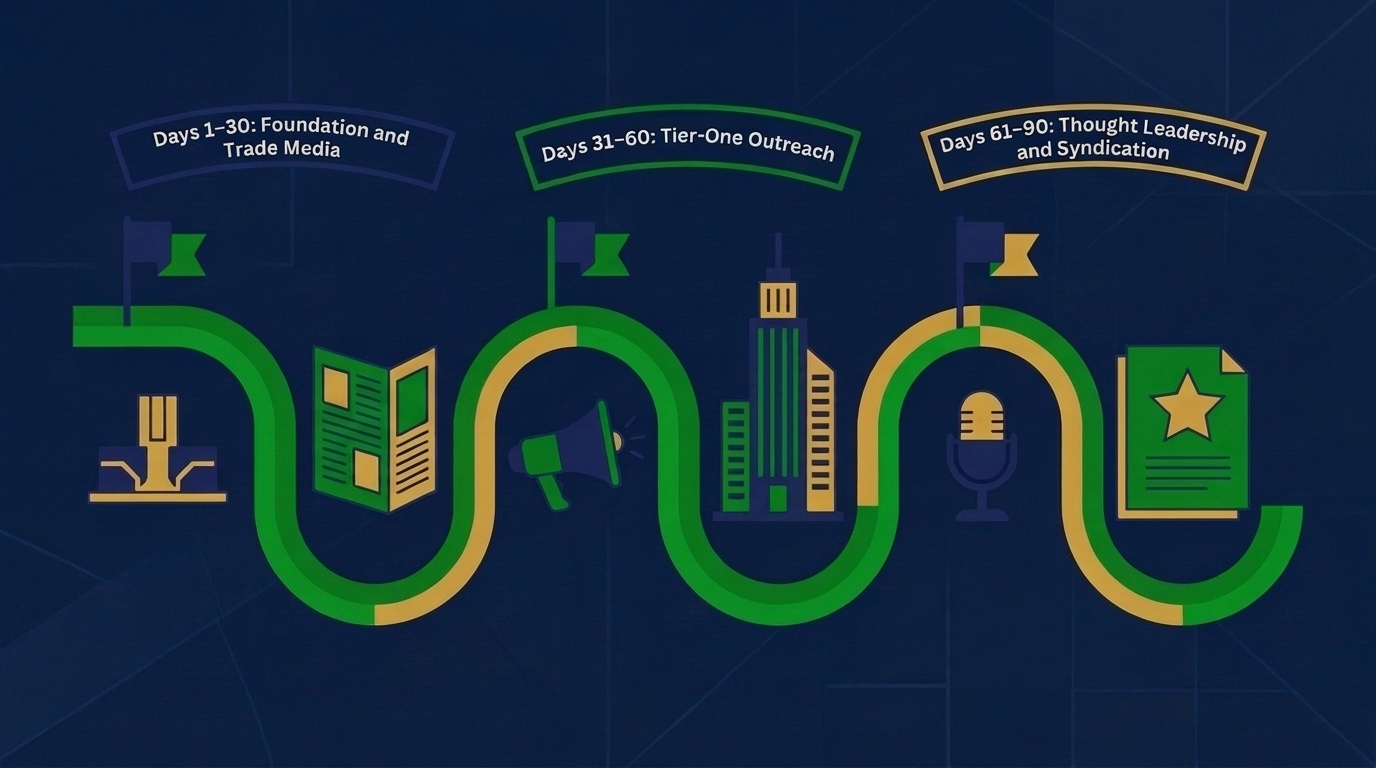
Days 1–30: Foundation and Trade Media
- First, finish your audit and pick three target topics.
- Next, fix facts on your site, profiles, and listings.
- Then, add schema markup for your organization and experts.
- Also, pitch five to ten trade outlets with expert angles.
Meanwhile, set up brand mention monitoring. That step gives your Generative Engine Optimization work a clean starting point. Later, you will compare every result against it.
Days 31–60: Tier-One Outreach
Next, aim higher. First, use your trade coverage as proof of credibility. Then, pitch national business and industry media.
- First, share your original data with top reporters.
- Next, offer executives for expert commentary.
- Also, respond fast to journalist requests.
Because tier-one coverage takes time, keep pitching steadily. Also, track every reply and placement. These records support your Generative Engine Optimization reporting later.
Days 61–90: Thought Leadership and Syndication
Now, turn your coverage into lasting assets. First, publish bylines that deepen your key topics. Then, syndicate approved pieces to trusted partners.
Next, here is how to optimize content for GEO on your own pages:
- First, lead each section with a direct answer.
- Next, use question-based headings.
- Then, add schema markup and cite your sources.
- Also, show author names, credentials, and update dates.
Finally, re-run your audit and compare results. As a result, you see what moved and what needs more work. That review completes your first Generative Engine Optimization cycle.
Case Studies: Real GEO Results from PR Campaigns
Next, these examples show Generative Engine Optimization in action. Each one comes from a verified client. Also, each follows the same format for easy comparison.
B2B Technology Brand
Challenge: Before the campaign, the brand had zero visibility in ChatGPT and Perplexity responses across all five target search queries. It was neither mentioned nor cited as a source in any of the AI-generated answers.
PR actions: Over a 90-day campaign, the strategy focused on securing thought leadership placements in two tier-one publications and getting the brand included in one analyst report. These placements were designed to strengthen the brand’s credibility, authority, and visibility as a trustworthy source for generative AI platforms.
Generative Engine Optimization result: After 90 days, the brand appeared as a cited source in three out of its five target queries across ChatGPT and Perplexity. This represented a measurable improvement from zero AI citations before the campaign to visibility in 60% of the targeted queries.
Professional Services Firm
Challenge: A competitor dominated AI-generated answers for the firm’s primary service query, leaving the firm with limited visibility and representation in AI-powered search results.
PR actions: Developed an executive profiling strategy and executed a data-driven PR campaign designed to strengthen the firm’s authority and credibility. The campaign secured six earned media placements across high-authority publications within 90 days.
Generative Engine Optimization result: Within 90 days, the firm gained visibility inside Google AI Overviews for four target queries, improving its representation in AI-generated search answers and narrowing the visibility gap against its competitor.
Measuring GEO Performance Beyond Traditional KPIs
Rankings and clicks tell only part of the story. In fact, traditional KPIs often miss Generative Engine Optimization results. So, here is how to measure the success of generative engine optimization campaigns.
Track these core metrics:
- First, AI share of voice, meaning how often AI names you versus rivals.
- Next, citations count across ChatGPT, Perplexity, and AI Overviews.
- Then, answer accuracy, meaning whether AI describes you correctly.
- Also, the sentiment of each mention.
- Finally, branded search volume and direct traffic.
Together, these metrics prove Generative Engine Optimization value. Also, they give your team clear targets.
Tools to Track AI Brand Mentions
Several tools now support Generative Engine Optimization tracking. For example, Profound, Ahrefs Brand Radar, and the Semrush AI toolkit monitor AI mentions. Meanwhile, Google Analytics shows referral visits from AI engines.
Still, tool results vary by method. So, pair them with manual prompt tests each month. Also, save screenshots as proof.
Attribution: Connecting Placements to AI Visibility
Attribution for Generative Engine Optimization is hard because AI answers rarely show a clear click path. Still, you can build a strong case. First, use a simple tracking process:
- First, log every placement with its date and outlet.
- Next, record your AI visibility each week.
- Then, note which new sources AI engines start citing.
- Also, ask new leads how they found you.
Over time, patterns appear. For example, a trade feature may come before a new Perplexity citation. That link supports your case, although it does not prove the cause.
Frequently Asked Questions About Generative Engine Optimization
Generative Engine Optimization (GEO) is changing how businesses build online visibility as more people rely on AI tools like ChatGPT, Perplexity, and Google AI Overviews for answers.
Understanding how these platforms discover, reference, and recommend brands is essential. Here are answers to common questions about GEO, AI visibility, and the role of digital PR.
What is the difference between GEO and SEO?
SEO ranks pages in search results. In contrast, Generative Engine Optimization earns mentions and citations inside AI answers. Still, strong SEO supports both.
How do I find out if my business appears in ChatGPT or Perplexity answers?
First, ask each engine the questions your buyers ask. Next, record whether your brand appears and which sources get cited. Also, use a monitoring tool, because Generative Engine Optimization needs ongoing checks.
How long does it take for PR placements to influence AI search results?
It depends on the engine. For example, Perplexity searches the live web, so new coverage can surface faster. In contrast, changes to a model’s core knowledge can take months.
So, plan for 90 days to see early Generative Engine Optimization signals.
Does getting featured in Forbes actually help with AI search visibility?
Yes, Forbes coverage can help Generative Engine Optimization. Forbes is a widely cited source, so a feature adds a strong signal. Still, engines weigh many sources, so consistent coverage matters more than one logo.
What types of content does Google’s SGE prioritize in AI overviews?
Google AI Overviews tend to favor clear, factual, well-structured content. Also, they favor sources with strong E-E-A-T. For example, direct answers, original data, and expert authors fit well.
Plus, schema markup helps engines read your page.
Can small businesses compete in generative engine optimization, or is it only for large brands?
Yes, small brands can win at Generative Engine Optimization. Because AI engines reward topical authority, a focused niche can beat broad reach. For example, a local firm can own one service in its city.
What’s the minimum PR investment to see GEO results?
It depends on your market and goals. Still, a focused PR Company retainer can fund trade media and expert bylines. So, start with one topic, and expand as results show.
Also, consistency matters more than budget size in Generative Engine Optimization.
How is GEO measured — what KPIs should I track?
For Generative Engine Optimization, track AI share of voice, citation count, answer accuracy, sentiment, and branded search. Also, add referral traffic from AI engines. Then, tie those numbers to leads and revenue.
Next Steps: How 9-Figure Media Builds Your AI Authority
Now, you know how PR builds authority for AI engines. Next, you can put that plan to work. At 9-Figure Media, we run Generative Engine Optimization programs built on earned media.
Here is how we help:
- First, we audit your AI search visibility across major engines.
- Next, we build a PR plan around your target topics.
- Then, we secure placements that create strong citation signals.
- Finally, we track results and report real progress.
So, are you ready to become the brand AI engines cite? Contact 9-Figure Media today to start your Generative Engine Optimization audit.