
PR KPIs, key performance indicators, are what separate teams that prove their value from those that simply hope leadership notices.
Great stories are at the heart of public relations. But in today’s data-driven world, a good story is only half the job.
If your PR reports still lead with media impressions and little else, it is time to rethink your approach.
This guide walks you through the PR success metrics that actually matter, how to track them, and how to turn your data into a report that executives trust.
What Are PR KPIs and Why Do They Matter?
PR KPIs are measurable values that tell you whether your public relations work is hitting its targets.
They go beyond raw numbers to show real performance, the kind that connects directly to business goals like revenue growth, brand visibility, and audience trust.
It helps to understand the difference between a metric and a KPI. A metric is just a number, for example, how many articles your team placed last month.
A KPI, on the other hand, is a strategic signal. It answers the question: did that coverage actually move the needle?
A strong PR KPI would measure the percentage increase in qualified website traffic that came directly from earned media.
Public relations key performance indicators tie your PR work to what leadership actually cares about.
They create accountability, give your team clear direction, and make it easier to defend your budget when it counts.
So if you want PR to be seen as a growth function rather than a cost center, you need to build your reporting around the right PR KPIs from the start.
Why PR Measurement Has Changed

Not long ago, PR teams measured success by counting press clippings. That approach no longer reflects how modern communications works.
Today, digital tools let you track exactly how your audience responds to coverage, and leadership expects you to use them.
Several forces are driving this shift. First, executives now demand proof.
Budget conversations have become harder, and teams that cannot show clear PR success metrics tend to lose when cuts come.
Second, PR now sits alongside SEO, content marketing, and paid media. Because these channels measure performance carefully, PR faces the same pressure.
Additionally, the tools available today make tracking far easier than it used to be.
Platforms like Google Analytics, media monitoring software, and social listening tools give PR teams real-time access to the data they need.
There is no credible reason to skip tracking PR KPIs rigorously.
The Core Categories of PR KPIs You Should Know
Understanding the way PR KPIs cluster can help you get a better grasp of each metric before looking at the specific ones in detail. All PR KPIs belong to one of four major clusters:
1. Awareness PR KPIs : Awareness PR metrics track the extent of the reach of your brand message.
The metrics include media impressions, reach in its totality, and share of voice, which measures your company’s brand presence compared to other brands.
The share of voice metric is particularly important when considering awareness PR KPIs, as it reveals your brand’s competitive standing.
2. Engagement PR KPIs: Unlike awareness PR metrics, engagement indicators show the actual impact of your news release.
The set includes such metrics as click-through rates, social media sharing statistics, duration of time spent reading a news piece, and number of comments.
3. Media Coverage KPIs: Media coverage KPIs focus on the quality and tone of your placements.
Not all press is equal, and this category helps you assess it properly.
A tier-one placement in a high-authority publication carries more weight than dozens of mentions in low-traffic outlets.
Sentiment analysis, whether coverage reads as positive, neutral, or negative, also belongs here. This is one of the most important PR success metrics for protecting brand reputation.
4. Conversion PR KPIs: These connect PR directly to business results. They track how many leads, sign-ups, or purchases came from earned media.
Conversion PR KPIs are often the hardest to set up, but they are also the most persuasive when you present results to stakeholders.
10 PR KPIs Every Team Should Track
1. Share of Voice
Share of voice (SOV) measures how much of the conversation in your industry your brand owns compared to competitors.
It is one of the most strategic PR KPIs because a rising SOV signals growing authority and market relevance.
Therefore, tracking SOV consistently helps you understand whether your campaigns are winning the battle for attention in your space.
2. Media Impressions vs. Real Reach
Impressions estimate total potential views, but they often overstate actual exposure. Real reach counts unique audience members who likely saw your content.
Smart teams track both, but they use real reach as the more reliable PR success metric when reporting to executives. Impressions are useful for benchmarking; reach is what actually tells the story.
3. Sentiment Analysis
Sentiment shows whether your coverage is positive, neutral, or negative. Positive sentiment builds brand equity over time, while negative sentiment, on the other hand, signals a reputational risk that needs addressing quickly.
Running sentiment analysis across all your media coverage KPIs gives you a fuller picture of how audiences perceive your brand, and where you need to course-correct.
4. Message Pull-Through Rate
This PR KPI measures how often your key messages appear in earned media coverage.
It answers a critical question: are journalists picking up the narrative you want, or are they going elsewhere? A high pull-through rate means your storytelling is working.
A low rate means you need to revisit your pitch angles and sharpen your messaging.
5. Backlinks and Domain Authority
PR has a direct and measurable impact on SEO.
Every high-quality backlink earned through a press placement improves your domain authority and helps your website rank higher in search results.
Therefore, tracking backlinks as part of your PR KPIs is one of the smartest ways to show cross-functional value and make a case for PR’s role beyond just earned media.
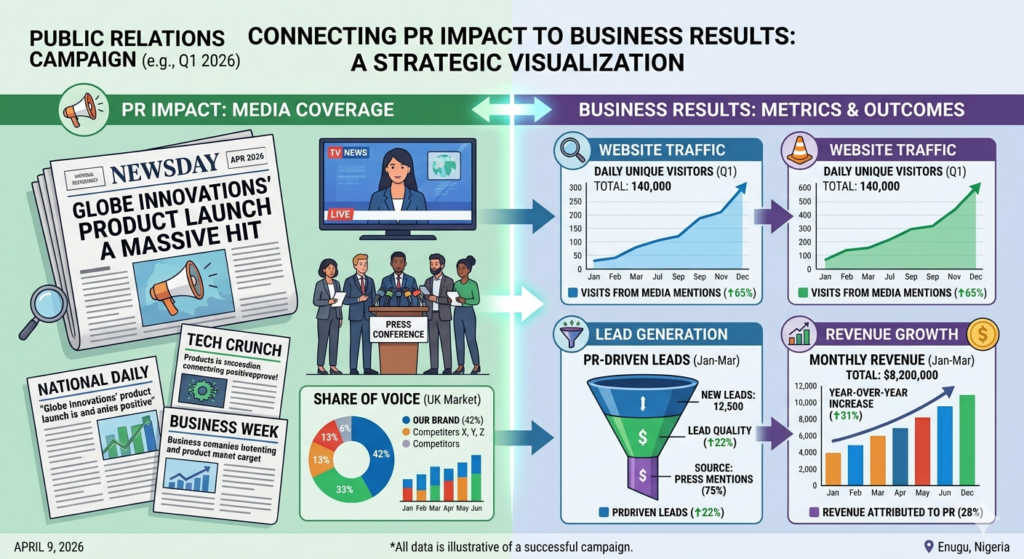
6. Website Traffic from Earned Media
Using UTM parameters and referral tracking in Google Analytics, you can measure exactly how much traffic each PR placement drives to your website.
This is one of the clearest media coverage KPIs available because it draws a straight line from a press mention to actual audience behaviour.
When you can show that a single article brought 2,000 visitors, that is a result leadership understands immediately.
7. Conversion Rate from PR Campaigns
This is arguably the most powerful PR KPI of all.
It tracks how many people who arrived at your site through earned media went on to take a meaningful action, signing up, downloading a resource, requesting a demo, or making a purchase.
Even a modest conversion rate can translate into significant revenue when your PR placements reach the right audience.
This metric turns earned media from a soft win into a hard business result.
8. Tier-One Media Placements
Not all placements carry the same weight. A feature in a nationally recognised publication is worth far more than twenty mentions in niche blogs.
Tracking the number and percentage of tier-one placements in your overall media coverage KPIs helps you make the case for PR’s quality, not just its quantity.
This metric also strengthens trust with leadership, who recognise strong outlets by name.
9. Journalist and Influencer Relationship Scores
This is a softer PR KPI, but it matters over time.
Teams that track response rates, relationship longevity, and repeat coverage from key journalists can show that they are building lasting media equity, not just chasing one-off placements.
Strong journalist relationships often lead to proactive story ideas, exclusive access, and more favourable framing.
That kind of trust is hard to put a price on.
10. PR-Influenced Pipeline and Revenue
For B2B teams especially, this is the ultimate PR success metric.
It tracks how many sales opportunities were touched by PR activity at some point in the buyer journey.
Even if PR was not the only touchpoint, showing its influence on pipeline proves that communications is a genuine growth driver, not just a brand awareness exercise.
How to Set SMART PR KPIs That Leadership Respects

Setting the right PR KPIs starts with the SMART framework.
Every KPI should be Specific, Measurable, Achievable, Relevant, and Time-bound. For example, “increase brand awareness” is not a PR KPI, it is a vague aspiration.
However, “increase website traffic from earned media by 25 percent within three months” meets every SMART criterion.
It tells your team exactly what to aim for, how you will measure it, and when you need to get there. Your PR KPIs should also connect directly to what your business is trying to accomplish.
If your company is focused on entering a new market, your PR KPIs should reflect that, tracking share of voice in that market, coverage in relevant trade media, and website traffic from that audience segment.
When PR KPIs map clearly to company strategy, they become far more persuasive in leadership conversations.
Tools That Make Tracking PR KPIs Easier
There is no need to calculate PR KPIs by hand, there are reliable solutions that will do all the work for you, making your reports sound much more professional in the process.
This list contains the most important of them:
- Media Monitoring Solutions (Meltwater, Cision, Mention): These platforms help to keep track of each brand mention, measure changes in sentiment and reach, and automate everything along the way. Such a solution can save your team hours per week.
- Google Analytics: The old but gold tool for measuring traffic and conversions from earned media. It shows from which press placement your referral comes and tracks their actions on your site.
- Social Listening Solutions: Track audience mentions and conversations about your brand across platforms. With social listening tools, you will get true insights based on the reaction to earned media and not just stats of placements.
- PR Dashboards: Consider these solutions your headquarters. They consolidate all the necessary metrics from different solutions into a single interface so that you would not need to have five tabs open during reporting sessions.
The smartest move is to use these tools together. When you connect the dots, from a press mention to a website visit to a conversion, you stop reporting activity and start showing real impact.
That is exactly what turns your PR success metrics into a story leadership wants to hear.
Common Mistakes Teams Make with PR KPIs
Even experienced PR teams make avoidable errors when it comes to measurement.
The first mistake is leaning too heavily on vanity metrics. Impressions look good in a slide deck, but they do not tell anyone whether PR is working.
Always pair reach metrics with engagement and conversion data to give them context.
The second mistake is skipping benchmarks.
Your PR KPIs mean very little without context. Compare your results against past performance, industry standards, and competitor share of voice so your reporting tells a complete, honest story.
The third mistake is poor attribution.
If you cannot trace a result back to a specific campaign or placement, you lose credibility with leadership.
Set up proper UTM tracking and work with your analytics team to build an attribution model that captures PR’s role in the buyer journey.
Finally, many teams track too many PR KPIs at once.
Instead, focus on five to seven that connect directly to your current business priorities. More is not better when it comes to KPI reporting, clarity is.
How to Present PR KPIs to Stakeholders
Data alone rarely convinces anyone. But a clear, well-structured PR report almost always does. The trick is to stop speaking in PR language and start speaking in business language.
Here is how to do it:
- Focus first on the best outcomes. Begin by highlighting achievements that have truly mattered. An impressive media placement that brought site visits, leads, or increased brand queries will definitely get the audience’s attention from the very beginning.
- Leverage the business impact of PR. Never let your media presence stand alone. Relate it to what really matters to the company – sales, growth, and visibility. Even when the link isn’t immediate, be sure to draw a direct line between PR activities and their tangible benefits.
- Let graphs do the talking. Visuals are more efficient than paragraphs when it comes to communicating numbers and trends. A well-crafted chart or trend line can tell your story much more effectively than several textual descriptions.
- Adjust the language of your KPIs to fit the audience. Are you addressing the CEO? Emphasize market penetration. Talking to the CFO? Highlight the cost-effectiveness of PR against paid advertising.
Turn PR reporting into an actual dialogue. When you align your KPIs with what leadership is already concerned about, the entire discussion takes on a new direction.
The goal is simple: make your numbers easy to follow, hard to ignore, and impossible to dismiss.
The Future of PR KPIs
PR measurement is moving fast. Predictive analytics tools are beginning to help teams forecast how a campaign is likely to perform before it even launches.
AI-powered sentiment analysis is becoming faster and more accurate.
Attribution models are improving, making it easier to show exactly where PR touches the customer journey, and how much it contributes to each stage.
Furthermore, the link between PR, marketing, and sales data is getting tighter. Teams that connect their PR success metrics to CRM data will soon be able to show PR’s influence on revenue with much greater precision.
Public relations key performance indicators will therefore become an even more central part of how communications teams plan, execute, and report their work.
The teams that invest in measurement now will be the ones that lead the conversation later.
Conclusion: Start Measuring What Actually Matters
There is no way around PR KPIs; they have become essential if you want your communication strategy to be taken seriously.
Once you figure out the right PR KPIs for your organization, you will be able to demonstrate the leadership of your company the value PR brings to the table and how it helps you build visibility, engagement, and achieve business growth.
Start by identifying between five and seven key PR KPIs based on your present objectives. Set your targets, implement the right metrics tracking tools, and establish a report routine.
This way, you will make it easier for your team to increase its reputation and get the budget allocated to PR.
PR has never failed to deliver amazing results, but now you can actually quantify them. Get started implementing PR KPIs in your strategy and enjoy impressive returns on investment.