
Public relations is no longer what it used to be, but it’s not what it used to be because it’s changed quickly, and it’s changed a lot. Which is why AI sentiment analysis PR is one of the most valuable tools a PR team can use today.
In today’s world, a single tweet can shift the way thousands of people think about a brand in a matter of minutes, while a news story can spread like wildfire before a PR team even gets their morning coffee.
In a world like that, waiting to find out what people think about a brand is no longer an acceptable strategy, a tool like this helps brands understand not just what people think about a brand but also how they feel about it.
Making it a valuable tool for any PR team that wants to stay one step ahead of the curve.
What Is AI Sentiment Analysis PR, and Why Does It Matter?
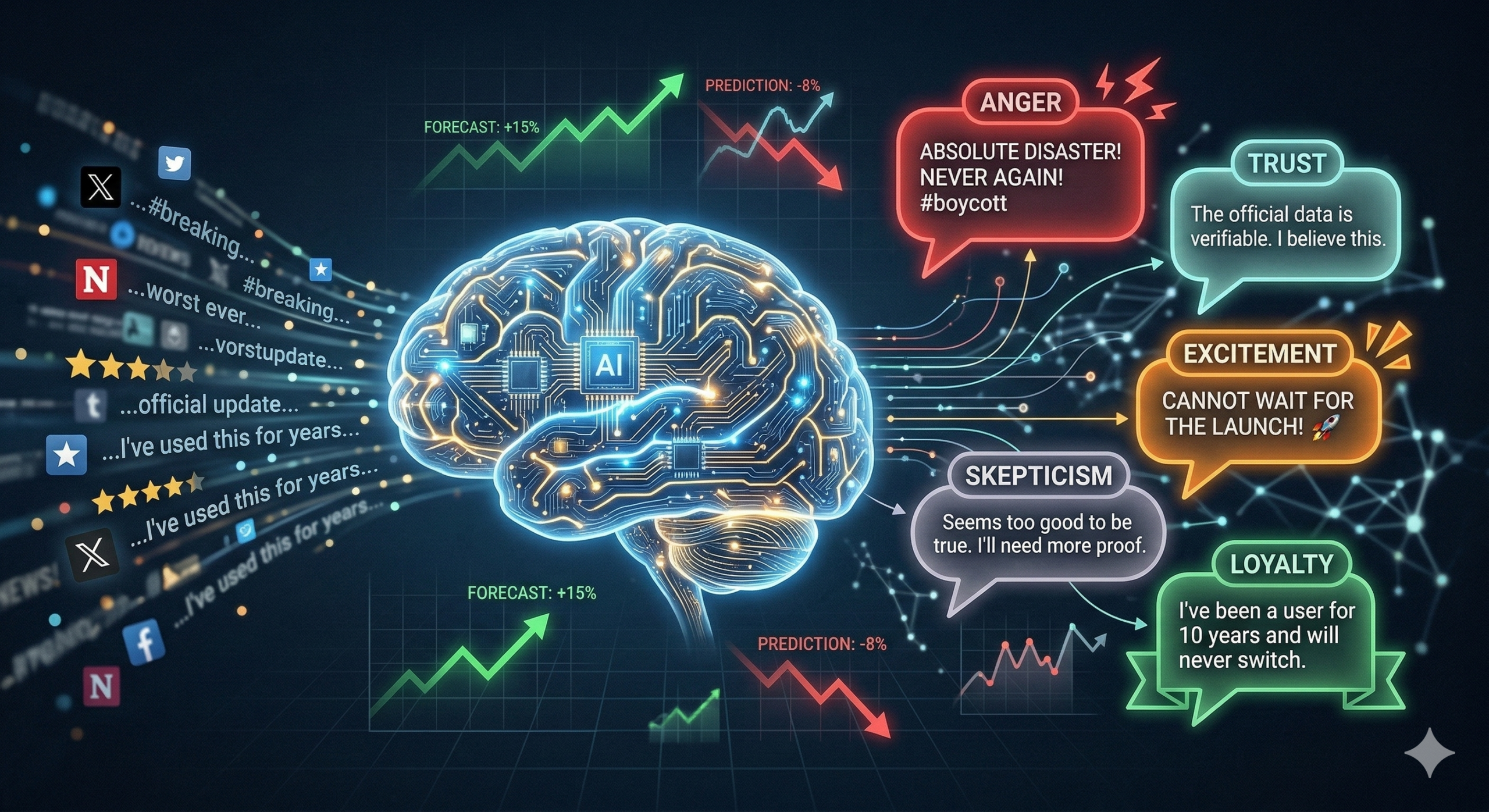
At its core, AI sentiment analysis PR is the application of artificial intelligence to read and interpret the emotional tone of content.
This includes news articles, social media posts, blog comments, online forums, and reviews.
This technology uses something called NLP or AI to scan content and determine whether the tone is generally positive, negative, or neutral.
More advanced technologies can actually detect subtle emotions like trust, frustration, and excitement.
So why is AI sentiment analysis PR different from traditional media monitoring?
It’s different in four key ways:
- Traditional media monitoring tells you how many times your brand is mentioned
- AI sentiment analysis PR tells you how people feel about those mentions
- It looks at thousands of sources at once
- It does this in real-time, not days later
The shift from monitoring mentions to monitoring emotions is a big one. Emotions are what drive people to take action.
They’re what make someone buy a product, share a recommendation, or give up on a brand altogether.
This is why AI sentiment analysis is exponentially more important than reach metrics will ever be.
Related: AI PR Strategies: Powerful Techniques For Maximum Media Impact

How AI Sentiment Analysis PR Supports Real-Time Reputation Management
One of the biggest advantages of using AI sentiment analysis for PR is the fact that it is quick. This is particularly important in situations where negative sentiment starts to build.
The fact of the matter is that a brand should know about this issue before it becomes a crisis.
Early Warning Systems That Actually Work
With the help of AI sentiment analysis tools, it is possible to get alerts the moment the tone of the public starts to change in a way that might be problematic for a brand.
This provides the necessary opportunity to respond to an issue and change direction if necessary.
For example, if a product recall situation were to occur, a brand might not have realized the fact that the tone of the public had changed until the day that journalists began to write about the issue.
This is no longer the issue. In this case, the tools available with this form of PR can spot the fact that negative sentiment is building days in advance.
The end result of this is crisis prevention rather than crisis response.
Tracking Your Reputation Score Over Time
This does not just help in emergencies. It also gives brands a continuous reputation score, a clear picture of how public perception is trending over weeks and months.
PR teams can use this to:
- Compare how a brand performed before and after a major campaign
- Spot gradual reputation drift before it becomes a real problem
- Benchmark against previous campaigns or industry averages
- Measure the long-term impact of key announcements
This ongoing tracking builds a living reputation report, always updated, always relevant.
Unlocking Brand Insights Through AI Sentiment Analysis PR
The real strength of AI sentiment analysis PR tools lies in the depth of information it provides. Sentiment analysis PR extends far beyond whether people are happy or sad.
Sentiment analysis PR helps to understand “why” and “who” and “where” simultaneously.
1. Audience Emotion Mapping
Not everyone may have the same opinion about a brand. Sentiment analysis PR helps to segment the audience based on the following:
- Demographics: Age Group
- Location: Geographic Location
- Platform: News, Social, Forum, Review, etc.
- Stakeholders: Customers, Investors, Employees, and Media
This helps in audience mapping, which is closely associated with Emotion AI. This helps in understanding where the brand enjoys maximum emotional support and where it lacks support.
Additionally, this aids in effective communication with the audience since the communication team understands with whom they are communicating and how they feel about the brand.
2. Campaign Performance in Real Time
Before AI sentiment analysis for PR, a campaign’s success was measured by waiting for the reports, which came days later.
In the current scenario, the data comes in during the campaign period.
This means that PR teams can:
- Monitor the emotional response of the people to the message
- Identify confusion and misunderstanding early on
- Make the necessary adjustments so that the message does not end up damaging the brand
- Monitor the level of trust prior to and after major announcements
This way, every campaign becomes a smarter one.
3. Competitive Sentiment Tracking
Not only does AI sentiment analysis for PR provide the brand with information about its success, but it also provides information about the success of the competitors.
By keeping an eye on the competitive sentiment, the brand can:
- Identify where the competitor has lost the trust of the people
- Identify the emotional stories that are trending in the market
- Identify the gaps, which provide opportunities for the brand
For instance, if a competitor has always been receiving complaints about the quality of service, a campaign highlighting the brand’s responsive nature can change the sentiment trend for the brand.
4. Smarter Media and Influencer Relationships
AI sentiment analysis helps identify which journalists and influencers consistently cover your industry with a positive tone and which ones push unfavorable narratives. This allows PR teams to:
- Build stronger relationships with clear brand advocates
- Prepare thoughtful, well-timed outreach for vocal critics
- Monitor rising voices before they gain major traction
Practical Uses of AI Sentiment Analysis PR Across Key Scenarios
AI Sentiment Analysis PR is not just for monitoring. It has very specific and tangible uses in a variety of PR situations.
Crisis Communication
In a crisis, AI sentiment analysis PR becomes the crisis center. Teams can monitor the health of public sentiment in real-time. This allows for:
- Decisions based on facts and figures on whether and how to respond to a crisis
- Prioritization of the worst of the worst narratives to respond to first
- Measuring the effectiveness of the response once it’s live
Product Launches
When a product launches, AI sentiment analysis PR tools pick up the initial response of the public in an instant.
Teams can see if the initial response to a product launch was successful and if a quick response to correct misconceptions is necessary.
ESG and Corporate Reputation
Environmental, Social, and Governance communication requires very specific tone management. The public has very little time for vagueness. AI Sentiment Analysis PR helps teams monitor:
- How the public is responding to ESG initiatives
- If greenwashing allegations are becoming prevalent
- How much trust is being built, or lost, with the public
Executive Reputation Management
Leaders are part of the brand.
AI sentiment analysis PR tracks how public sentiment around executives shifts after interviews, speeches, or media appearances, helping protect leadership credibility before it becomes a headline issue.
Tools and Implementation: Getting AI Sentiment Analysis PR Right
Not all sentiment tools are created equally. When considering a platform for AI sentiment analysis PR, there are a few key areas to consider:
- Contextual accuracy: Does it have any understanding of sarcasm or nuance?
- Multilingual: Does it have the capability to perform in multiple languages?
- Cross-platform: Does it monitor news sources, social media, forums, and product reviews?
- Customization: Does it have options to tailor the results to your industry?
Integrating Into Your Existing PR Stack
For AI sentiment analysis PR to be effective, it is crucial that it integrate with the tools that your organization already uses.
This means that there is a unified platform that includes reach and engagement in addition to sentiment analysis.
Furthermore, this platform should also integrate with customer relationship management tools to give a better understanding of stakeholders.
Finally, this platform should also have the capability to automate alerts to ensure that communication efforts are maximized.
Knowing the Limitations
While AI sentiment analysis PR is incredibly powerful, there are also a few limitations that should be considered. These include:
1. Sarcasm or irony in casual conversation
2. Regional dialects or slang
3. Meeting data privacy laws that vary from country to country
The smartest approach is to combine AI insights with human judgment, not replace one with the other.
Measuring the Business Impact of AI Sentiment Analysis PR
Perhaps the most intriguing thing about AI sentiment analysis in PR is its capacity to help bridge the gap between reputation management and concrete business results.
For example, by monitoring the growth of positive sentiment over a given period of time, a company will be able to witness a direct correlation with increased customer loyalty.
In addition, robust word-of-mouth support and improved investor relations, not to mention significant improvements in employee engagement and recruitment strategies.
As PR professionals use this tool to help explain the way this change in public perception translates back into the company’s brand equity and revenue streams.
The very debate around PR is shifted from abstract notions into a much more concrete reality.
This is a tool that offers a definitive way to tap into the power of emotional data and turn it into results that propel the entire business forward.
Reporting Sentiment to Leadership
Leadership types want information in simple and straightforward ways. As a result, an effective way to report sentiment analysis PR results might include the following:
- Visual trend lines to show changes over time
- Emotional scoring that is easily digestible at a glance
- Specific suggestions based on actual data
Perhaps the single most interesting aspect of this process is the way in which emotional scoring translates into actual business results.
How AI Sentiment Analysis PR Works in Practice: A Real-World Scenario
To get a sense of the true value of AI sentiment analysis for PR, it’s worth working through an example of how a brand might use the tool during a product launch.
Before the Launch
The brand uses AI sentiment analysis PR tools to monitor the social sentiment around the product category beforehand
NLP capabilities in the PR tool show the brand that consumers are skeptical about the transparency of the product’s ingredients
This information is then used to modify the message beforehand to address these concerns
During the Launch
Real-time data is then used to monitor the overall sentiment around the product launch
AI sentiment analysis PR tools identify a trend where consumers were initially confused about the product’s price
This trend is then addressed quickly to prevent the spread of the confusion
Competitive sentiment analysis is also used to identify the weaknesses of the competitors
This information is then used to sharpen the overall message
After the Launch
The overall reputation is then tracked on a weekly basis
Sentiment analysis shows a steady increase in the overall positive sentiment around the product
Emotion AI is also used to confirm the overall sentiment change from curiosity to trust
This is turning emotional data into smarter decisions at every stage.
The Future of AI Sentiment Analysis PR
The tech behind AI sentiment analysis PR is evolving rapidly.
Consequently, while it is impressive to consider what AI sentiment analysis PR can now achieve, it is even more thrilling to consider where it is headed.
Predictive Modeling: The Next Step in AI Sentiment Analysis PR
The future of AI sentiment analysis PR tools will not only be about telling you what has already transpired. Rather, it will also allow for predictive modeling to reveal to you:
1 How the public is likely to respond to your upcoming campaign
2 What topics are trending toward becoming problematic
3. What shifts in narrative are on the horizon in earned media
4 This is the promise of the shift from reactive to truly anticipatory PR.
Emotion AI: Taking Context to the Next Level
The future of AI sentiment analysis PR tools using emotion AI will not only be about determining if the sentiment is positive or negative.
Rather, it will also be able to determine if the sentiment is a mix of positive and negative.
For example, it will be able to distinguish between optimistic caution and curious skepticism. Such nuance will make AI sentiment analysis PR an even more formidable force in the future.
Intelligence-Led PR Is the New Standard
The bottom line is this: AI sentiment analysis PR is turning public relations into a data-driven, strategic discipline.
PR teams that embrace this shift will operate less like reactive communicators and more like forward-thinking reputation strategists who can read the room before anyone else.

Conclusion: AI Sentiment Analysis PR Is No Longer Optional
The winning brands in the current communication environment are not the ones that have the deepest pockets.
They are the ones that have the best intelligence. AI sentiment analysis PR delivers exactly that: the best intelligence to react faster, communicate more effectively, and mitigate reputation risks before they escalate.
Whether it’s reputation tracking, predictive modeling, competitor sentiment analysis, or executive perception, AI sentiment analysis PR offers the full gamut of public relations.
The debate about whether you need AI sentiment analysis PR for your brand is no longer relevant. It’s about whether you can afford not to.