
Pre-launch PR is the strategic use of public relations, media coverage, and audience-building tactics in the weeks and months before a product goes live
Most startups treat their product launch like a singular event. They build for months or years, finalize the product, and then launch on launch day.
The results are almost always the same. A brief spike of activity among people who already knew about the company, followed by silence.
At 9-Figure Media, pre-launch PR is not a promotional tactic. It is the strategic infrastructure that ensures your product enters a market already conditioned to care.
We position startups to arrive with demand, credibility, and narrative control, not just announcements.
CB Insights research cited by Ronn Torossian in April 2025 noted that companies that invest in pre-launch marketing see up to 30% higher day-one sales compared to those that do not.
This article covers the essential pre-launch PR steps every startup must take before day one.
From building your narrative foundation 3 to 6 months out, to coordinating your media embargo strategy in the final weeks. You will learn how to sustain the momentum that turns a launch into lasting growth.
Why Pre-Launch PR Changes Everything
Pre-launch PR exists because product launches follow a specific psychological and commercial logic. The most successful launches do not introduce a product to an audience.
They reveal a product to an audience that is already excited, already educated, and already waiting.
Think about how Apple approaches this. Their product launches generate massive media coverage and consumer interest weeks before any official announcement.
Customers line up before the product is available because the pre-launch PR campaign has already done its work.
The same principle applies to startups at any scale. When Robinhood was building toward its launch, a pre-launch referral waitlist helped it amass one million signups before the product went live. This demonstrates the power of pre-launch buzz at scale.
When Spotify launched in the US market, they provided selected media outlets with exclusive beta access.
This resulted in extensive pre-launch coverage across major tech publications.
This strategy helped them secure over one million US subscribers within their first month. This was according to Ronn Torossian’s April 2025 analysis of pre-launch buzz strategies.
For startups, pre-launch PR serves three purposes at once. First, it builds an audience of early adopters who are primed to try, buy, and spread the word the moment the product is available.
Secondly, it generates media coverage in advance, so that launch day features a wave of press rather than a single press release.
Additionally, it builds brand credibility that makes every subsequent PR pitch, investor conversation, and enterprise sales cycle easier.
The Cost of Launching Without Pre-Launch PR
The reverse is equally instructive. Startups that launch without pre-launch PR typically encounter a phenomenon every founder dreads: the quiet launch.
A quiet launch happens when a startup builds a great product and announces it on day one, only to discover no one is paying attention.
From 9-Figure Media’s standpoint, a quiet launch is the predictable outcome of entering the market without narrative equity or media alignment.
Startups that skip pre-launch PR don’t just lose attention; they forfeit the compounded visibility that drives authority, trust, and revenue.
No journalists are waiting for the story because no relationship was built. Also, no audience is refreshing the site at midnight because no waitlist was created.
No influencers are sharing the news because no early access was offered.
While many factors contribute to these failures, launching to an unprepared audience with no pre-launch PR foundation is consistently among them.
The good news is that pre-launch PR does not require a large budget.
It requires a clear strategy, consistent effort over several months, and the discipline to build relationships and audience before you need them.
The Pre-Launch PR Timeline: What to Do and When
The most effective pre-launch PR strategy is built around a clear timeline that begins 3 to 6 months before launch day. It accelerates systematically as the launch date approaches.
At 9-Figure Media, we engineer pre-launch visibility through a phased timeline.
This timeline builds authority, primes media relationships, and orchestrates attention in waves.
Each stage moves you from obscurity to inevitability before your product goes live.
Pre-Launch PR Strategy: Phase-by-Phase Timeline
Sources: CB Insights pre-launch marketing research, Ronn Torossian pre-launch buzz analysis (Apr 2025)
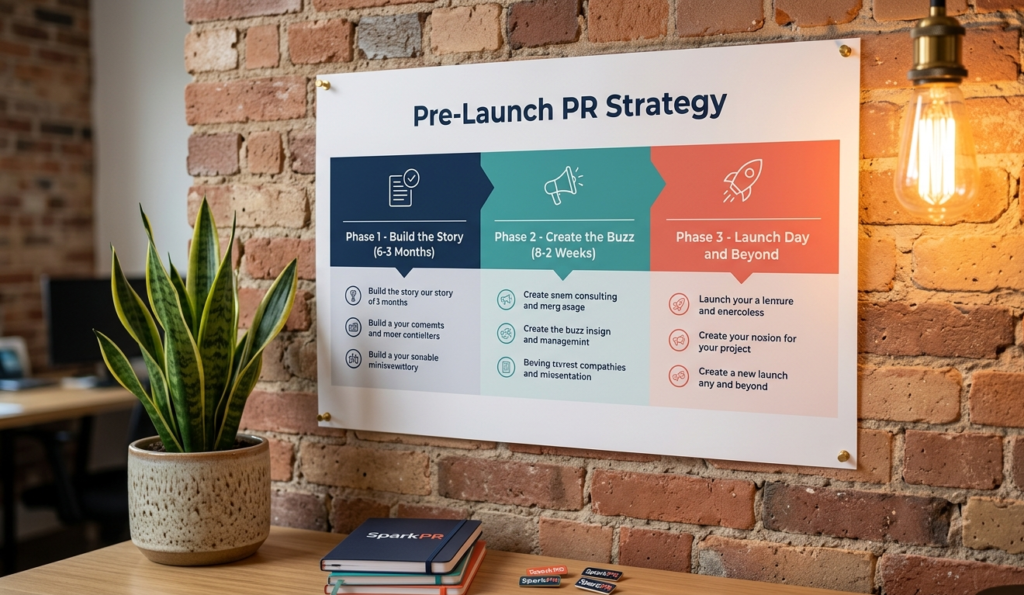
Step 1: Build Your Story Before You Need Coverage
The foundation of effective pre-launch PR is a compelling story that gives journalists, influencers, and early adopters a reason to care about your product before it is available.
The biggest mistake startups make in pre-launch PR is waiting to announce a product before developing their story. The story should come first.
9-Figure Media approaches pre-launch PR as a precision system where each phase compounds momentum, ensuring no effort is wasted, and every touchpoint builds toward dominance on launch day.
People are drawn to stories of purpose and progress. When you share a clear mission and who it helps, you give your audience a reason to root for you.
Practically, building your story for pre-launch PR means writing a clear messaging document that answers four questions:
- What specific problem does your product solve, and who feels that problem most painfully?
- Why does this problem matter now, and what has changed in the world that makes your solution timely?
- What makes your approach to this problem different from anything that currently exists?
- What is the founder’s personal connection to this problem, and what does that connection tell people about your commitment to solving it?
This messaging document becomes the foundation for every pre-launch PR activity that follows. It is what you pitch to journalists and share with early beta users.
It is also what your founder posts about on LinkedIn, and what your PR agency uses to build your media narrative.
Step 2: Build Journalist Relationships Before You Pitch Them
Pre-launch PR fails most often not because the product is bad or the story is weak.
It fails because the startup tries to pitch journalists they have never interacted with on a story with no prior context.
The solution is to build journalist relationships in the 3 to 6 months before your launch. This relationship-building phase of pre-launch PR includes:
- Following and engaging with the journalists who cover your sector on LinkedIn and X. Comment meaningfully on their published pieces. Share their articles with genuine context. Become a name they recognize before you become a name in their inbox.
- Positioning your founders as expert sources on the topics your product addresses. Use platforms like HARO and Qwoted to respond to journalist queries in your domain. Each expert quote you provide builds your reputation as a credible, accessible source.
- Share market data, original research, or non-product industry observations with journalists who cover your space. When you give journalists something genuinely useful that isn’t about your own product, you show you understand their needs and are worth adding to their source network.
Research each journalist’s specific beat, their most recent coverage, and their angle on your market.
Doing this before you ever send an email significantly increases your success rate when the pitch finally goes out.
How to Pitch Your Pre-Launch Story to Journalists
When you are ready to pitch your pre-launch story, your approach determines whether you get the feature you need or a polite decline.
At 9-Figure Media, we treat pitching as story placement, not information distribution.
We engineer pitches that align with editorial demand, making your story not just relevant, but irresistible to publish.
- Lead with the story, not the product. Your subject line and opening sentence should name the problem or the market trend you are addressing, not your product’s name or features. Journalists cover stories, not products.
- Offer exclusives for your most important target placements. Give your first-choice publication the right to break your story before anyone else. This incentivizes them to write a deeper, more favorable piece than they would if competing with five other outlets publishing simultaneously.
- Include specific, verifiable data in the pitch. Mention your waitlist numbers, your beta user retention rate, or market statistics that give the journalist a hook they can use. Vague pitches about disrupting a market get deleted. Specific pitches with a compelling number get read.
- Offer access: beta access, a demo, an interview with your founder, or customer testimonials from your early users. The more you give the journalist to work with, the more likely they are to write a substantive piece rather than a brief.
Step 3: Build Your Waitlist and Early Audience
Pre-launch PR is most effective when it flows into a mechanism for capturing interested people before they drift away.
That mechanism is your pre-launch waitlist. This landing page converts media attention and organic interest into a committed audience of early adopters ready to act on day one.
The most effective pre-launch landing pages include a benefit-focused headline.
This explains the problem you solve, social proof from beta users or early press mentions, a single clear call to action, and one email capture form.
The connection between your pre-launch PR coverage and your waitlist is critical. Every press mention should link to your waitlist page, not your product homepage.
Consequently, encourage every beta user you give early access to share the product on social media and refer friends to the waitlist.
Every influencer mentioned should drive their audience to sign up.
Robinhood’s approach demonstrates the power of this connection at scale. Their referral waitlist mechanism, which let early signups move up the queue by referring friends, helped them amass one million signups before launch.
That is pre-launch PR and pre-launch audience-building working together to create genuine market demand before a product is commercially available.
Step 4: Use Beta Access Strategically as Pre-Launch PR
Beta access is one of the most underused tactics in pre-launch PR.
Offering early, limited access to a carefully selected group of users before launch serves multiple pre-launch PR purposes at once.
First, beta users become your first advocates. People who feel like insiders, who got access before anyone else, are dramatically more likely to share, refer, and evangelize your product on launch day.
Their authentic enthusiasm, shared with their own audiences, carries far more credibility than any press release.
Beta access gives journalists and influencers something concrete to write about and demonstrate.
A journalist who has used your product for 3 weeks before writing about your launch produces a much more detailed, credible, and compelling feature than one who is relying solely on your press materials.
That depth of coverage is worth far more in pre-launch PR terms than a brief mention.
Additionally, beta access generates the user stories and testimonials that make your launch day press release, your landing page, and your sales conversations far more compelling.
A founder saying their product is great is expected. A named beta user from a recognizable company saying the same thing is social proof that investors, customers, and journalists all respond to.
The most effective pre-launch PR programs typically give beta access to three distinct groups:
- A small group of journalists in your target publications who will write about your launch; give them 2 to 4 weeks with the product.
- A group of influential voices in your industry- founders, operators, analysts- who will share their experience publicly on launch day.
- A broader group of target customers whose testimonials and usage statistics you can reference in your launch press release and pitch materials.

Step 5: Coordinate Your Launch Day Coverage
All the pre-launch PR work you have done in the preceding months builds toward this moment.
Launch day PR is not a single announcement; it is a coordinated release of multiple pieces of coverage across multiple publications and formats, timed to create momentum that is difficult to ignore.
The structure of effective launch day pre-launch PR coordination includes:
- One primary exclusive feature in your most important target publication, agreed in advance under embargo. This is the anchor piece that breaks your story and gives you the most prestigious coverage of the day.
- Two to four supporting features in secondary publications that have been briefed under embargo and published simultaneously when the exclusive goes live.
- A coordinated social media moment: your founders post simultaneously on LinkedIn and X at the launch hour. Your early beta users, briefed in advance, share their experiences at the same time. Your investors and advisors amplify the news through their own networks.
- A press release distributed through a wire service that makes your official company statement available to any journalist who did not receive the exclusive or embargo briefing.
The goal of this coordination is to create a news-cycle effect: a moment when your startup’s name appears across multiple credible sources simultaneously.
This creates the impression of widespread market validation that a single announcement can never achieve.
That impression of momentum is itself a pre-launch PR asset, because it attracts additional media interest, social sharing, and word-of-mouth from people who see multiple trusted sources talking about the same thing at the same time.
Pre-Launch PR Is the Work That Makes Day One Count
A great product deserves a great launch. But great products launch into empty rooms every day because founders treat launch day as the beginning of their PR work rather than the culmination of it.
At 9-Figure Media, launch day is never the beginning; it is the visible outcome of months of strategic narrative engineering.
We ensure that when your product goes live, the market is not discovering you for the first time; it is responding to a story it already believes.
The audience is waiting. The journalists are ready. The coverage is scheduled. The waitlist is full. The early adopters are excited. All that’s left is to open the doors.
Start your pre-launch PR strategy today, regardless of how far away your launch date is. Build your story. Meet your journalists.
Create your waitlist. Give beta access to the right people. Then coordinate your launch day coverage so that when day one arrives, you are not hoping for attention; you have already earned it.
The launches that change a company’s trajectory are planned months in advance.
Every successful startup launch you have ever admired was built on pre-launch PR work that most people never saw. Now you know what it takes to do it yourself.