
Let’s say you are a health-tech startup founder, staring at your laptop and refreshing your email for the hundredth time. After months of trying to get published in a major financial publication, you felt invisible in a crowded fintech marketplace.
Indeed, the struggle to secure startup media placements isn’t just about recognition; it’s about survival in today’s hyper-competitive business landscape.
This is to say that every day, thousands of entrepreneurs face this challenge: how to get published as a startup when established brands dominate headlines.
Consequently, startups can use Financial Tech Times to grow into an industry authority. Financial Tech Times creates industry leaders and validates emerging voices in financial technology.
Likewise, 9-Figure Media has spent over 11 years mastering startup media placement strategies, helping countless entrepreneurs break through the noise and get published in top-tier publications.
Throughout this comprehensive guide, you’ll discover the exact blueprint we use to secure coveted spots in Financial Tech Times.
The Advantage of Getting Published in Premium Financial Media
When startups successfully get published, something remarkable happens to their outlook. Beyond immediate credibility, these startup media placement create ripple effects that transform entire business trajectories.
Consider these compelling statistics:
- Financial Tech Times reaches over 2.6 million monthly readers
- Includes C-suite executives and venture capitalists controlling billions in investment capital
- Carries a domain authority score of 92, significantly boosting SEO rankings
- “As Featured In” Social Proof Increases Conversion Rates by up to 40%
The media placement strategy becomes powerful when understanding the publication’s influence.
Moreover, when they link to your website, search engines view your brand as significantly more credible and authoritative.
Hence, this SEO benefit drives organic traffic for years after initial publication.
In addition, the psychological impact on potential customers cannot be understated. When prospects see “As Featured in Financial Tech Times” on your website, it immediately elevates your startup’s perceived value and trustworthiness.
Long-term benefits of startup media placement include:
- Enhanced search engine rankings and visibility.
- Social media credibility and shareability grow stronger.
- Investor relations improve, boosting fundraising potential.
- Partnerships and business development opportunities become more robust.
Cracking the Get Published Code

Furthermore, understanding how to get published in the Financial Tech Times begins with decoding the editorial mindset. Unlike general business publications, editors focus on stories intersecting finance and technology meaningfully.
The editorial team prioritizes three core story types that consistently get published:
- Breakthrough innovations solving real financial problems
- Regulatory developments impacting the industry
- Human interest stories showcasing entrepreneurial resilience
In addition, timing plays a crucial role in editorial decisions. Financial Tech Times operates on sophisticated editorial calendars aligning with:
- Industry events and conferences
- Earnings seasons and financial reporting periods
- Regulatory announcement cycles
- Market trend developments
To emphasize, the publication’s editorial hierarchy consists of specialized beat reporters, section editors, and executive editors.
Subsequently, building relationships across this hierarchy creates multiple pathways for startup media placement success.
Successful startup media placement examples often include:
- Data-driven insights revealing industry trends
- Regulatory compliance innovations solving widespread problems
- Funding announcements tied to market expansion plans
- Strategic partnerships creating new market opportunities
- Technology breakthroughs with measurable business impact
Transform Your Business Into an Irresistible Media Story
Undoubtedly, creating compelling startup stories that editors can’t resist requires strategic thinking and emotional intelligence.
Equally, the best media placement strategies don’t just report facts; they craft narratives resonating with readers and inspiring action.
Conversely, your story development framework should follow the hero’s journey structure:
- Challenge identification and market problem
- Struggle phase with obstacles and setbacks
- Breakthrough moment with an innovative solution
- Transformation and measurable impact
Above all, start by identifying your unique angle. What makes your fintech startup different from thousands of others seeking to get published?
Perhaps, you’ve solved a problem affecting millions of consumers, or developed technology that dramatically improves financial inclusion.
Notably, data-driven narratives particularly appeal to Financial Tech Times editors. They want measurable results:
- User growth statistics and adoption rates
- Transaction volumes and processing metrics
- Cost savings and efficiency improvements
- Customer satisfaction scores and testimonials
Significantly, the most effective media placement strategies incorporate these essential elements:
- Clear problem statement affecting the target audience
- Innovative solution addressing the problem uniquely
- Measurable results proving solution effectiveness
- Future vision inspiring readers about industry possibilities
- Human elements make the story relatable and memorable
The Art of Irresistible Media Outreach to get Published
By all means, crafting pitches that consistently get published requires understanding busy editors’ psychology. Your startup media placement depends on standing out through strategic communication, demonstrating immediate value.
Successful pitch templates follow this proven structure:
- A compelling subject line creates curiosity while indicating news value
- Personalized opening referencing the editor’s recent work
- Clear news angle with obvious relevance to readers
- Supporting evidence, including statistics and testimonials
- Specific call-to-action with next steps
For the most part, subject lines that get published typically include specific metrics or outcomes:
- Fintech Startup Reduces Banking Costs by 73% Using AI
- Former Goldman Sachs VP Launches Revolutionary Payment Platform
- New Blockchain Solution Processes 50,000 Transactions Per Second
To explain, your news angle must be immediately apparent and genuinely newsworthy.
However, avoid generic announcements unless they include unique elements differentiating your story. Focus on the “so what” factor, making your news relevant to readers.
As a result, the follow-up sequence requires a delicate balance between persistence and respect. How hard it is to get published often depends on staying visible without becoming annoying.
Strategic follow-up schedule:
- Initial pitch email with compelling subject line
- Gentle reminder after one week with additional context
- New angle or news hook after two weeks
- Final attempt with a different story approach after one month
Becoming an Industry Authority: Media Placements for Startups
Without doubt, building lasting relationships with Financial Tech Times journalists transforms occasional startup media placement into consistent coverage opportunities. The most successful entrepreneurs understand that media placement strategies extend beyond individual pitch campaigns.
Equally important, relationship building begins with providing value before asking for anything. Share relevant industry insights:
- Exclusive data enhancing their existing stories
- Expert source connections for their articles
- Breaking news tips relevant to their beat
- Industry trend analysis and predictions
Identically, LinkedIn has become the primary networking platform for media professionals. Engage thoughtfully. Share their articles with insightful comments. Participate in industry discussions they initiate.
For example, connect with personalized messages referencing their work and offer expert quotes when they request sources.
Surely, industry events provide invaluable face-to-face networking opportunities. Conference interactions allow personal connections, making future pitches more likely to get published.
Certainly, becoming a go-to expert source requires:
- Timely responses to media inquiries across all channels
- Well-researched perspectives on industry developments
- Access to unique data or customer insights
- Availability for breaking news commentary
- •Professional communication respecting editorial deadlines
Strategic Timing That Multiplies Startup Media Placements for Success
Indeed, understanding when to pitch your story can differentiate between getting ignored and securing prominent startup media placements.
The publication’s editorial calendar aligns with:
- Major fintech conferences and industry events
- Earnings seasons and quarterly financial reporting
- Regulatory announcement periods and policy changes
- Market trend cycles and economic developments
Optimal pitching times include:
- Tuesday through Thursday mornings for the highest response rates
- Q4 for year-end analysis and future predictions
- Q1 for new initiatives and fresh start stories
- Q2 and Q3 for growth stories and market developments
Surprisingly, breaking news opportunities, known as newsjacking, allow agile startups to get published by providing expert commentary on developing stories.
Monitor industry news closely and prepare rapid response capabilities.
Strategic timing considerations:
- Industry Event Coordination: Pitch stories complementing major conference themes.
- Regulatory Calendar Alignment: Time announcements with policy development cycles.
- Competitive Landscape Awareness: Avoid periods when competitors dominate the news.
- Economic Cycle Recognition: Adjust messaging based on market sentiment.

Get Published: Media Empire Building
Significantly, successfully securing your first startup media placements in Financial Tech Times creates momentum that savvy entrepreneurs leverage into comprehensive media strategies.
By all means, your initial Financial Tech Times feature becomes the foundation for your startup media placement expansion.
Subsequently, this credible coverage serves as social proof when pitching other publications, dramatically improving acceptance rates.
Cross-promotion strategies maximizing value:
- Share coverage across all social media channels
- Include in email signatures and marketing materials
- Feature prominently on website and investor presentations
- Reference in future pitch campaigns to other publications
Building comprehensive media kits becomes essential as coverage grows. Include:
- High-resolution founder photos and company logos
- Key statistics and performance metrics
- Customer testimonials and success stories
- Links to all previous startup media placements.
Best media placements for startups create compounding returns through:
- SEO Benefits: Multiple high-authority backlinks improve search rankings
- Investor Interest: Media coverage attracts funding opportunities
- Customer Acquisition: Prospects trust featured startups
- Team Building: Quality coverage attracts top talent
- Industry Recognition: Regular media presence establishes thought leadership
Pitfalls That Destroy Media Placements for Startup Credibility
Generally, understanding how hard is it to get published often comes down to avoiding common mistakes that immediately disqualify pitches from editorial consideration.
The most destructive mistakes include:
- Treating journalists like advertising sales representatives
- Sending generic pitch templates to multiple publications
- Over-pitching with multiple emails per week
- Poor timing, ignoring editorial cycles
- Following up too aggressively after rejection
Common rejection reasons:
- Lack of News Value: Story doesn’t offer unique insights
- Poor Timing: Pitch conflicts with major news cycles
- Insufficient Evidence: Claims lack supporting data
- Wrong Audience Fit: Story doesn’t align with readership
- Generic Messaging: Pitch could apply to any publication
Above all, professional communication standards matter more in media relations than in most business contexts.
For this reason, poor grammar, informal tone, or unclear messaging immediately signals amateur status and reduces chances to get published significantly.
Hence, startup media placement require authentic news value, not promotional content disguised as journalism.
To sum up, focus on stories that genuinely inform, educate, or inspire readers rather than advertisements disguised as editorial content.
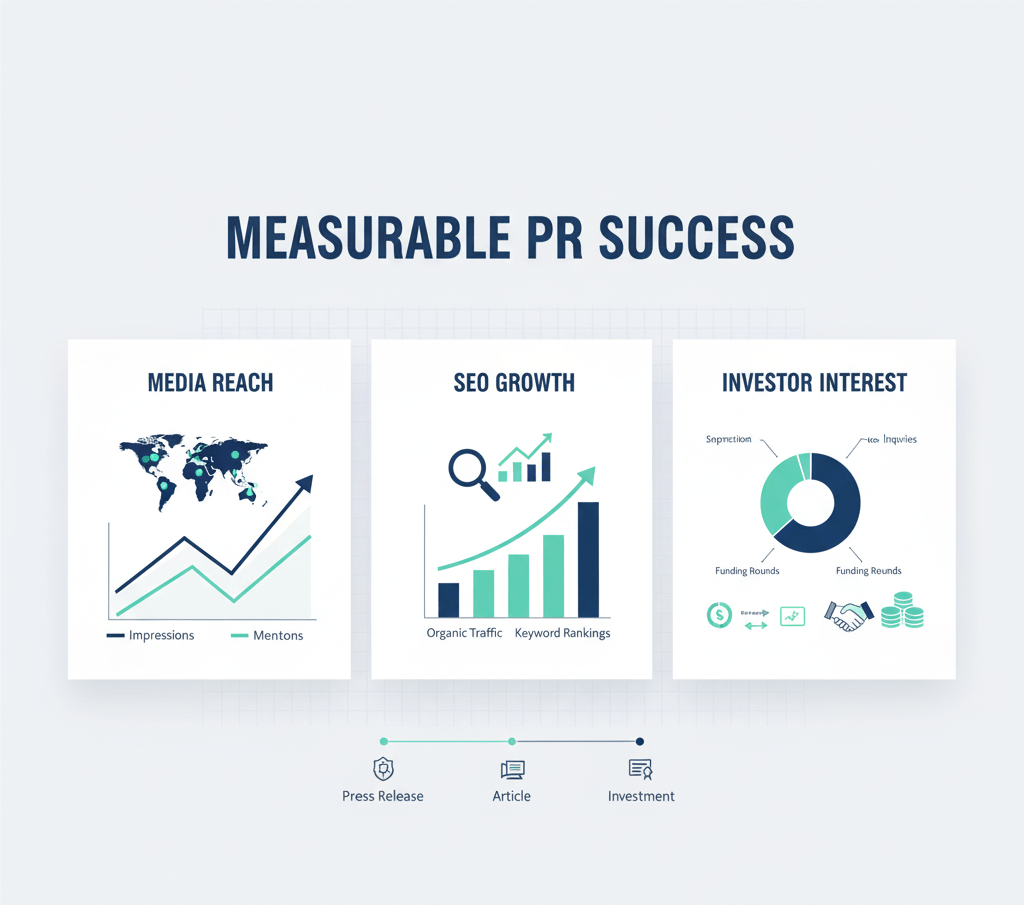
Tracking and Measuring Startups Media Placement Strategy
Comparatively, successful startup media placement require systematic measurement and continuous optimization based on performance data. at the same time, understanding which strategies get published and generate business results enables refined approaches.
Key performance indicators for media success:
- Coverage Volume: Number of articles, interviews, and mentions per quarter
- Publication Quality: Domain authority and audience size of covering publications
- Traffic Generation: Referral visitors and conversion rates from media sources
- Social Amplification: Shares, comments, and engagement on published content
- Business Impact: Leads, sales, and partnerships attributed to media coverage
Website traffic analysis provides immediate insights into media coverage impact.
Monitor referral traffic from Financial Tech Times to understand which stories drive engaged visitors. Google Analytics tracks user behavior, conversion rates, and revenue attribution from media sources.
Brand awareness metrics require both quantitative and qualitative measurement:
- Branded search volume increases following startup media placements
- Social media mention growth and sentiment analysis
- Customer surveys about company discovery methods
- Industry recognition and thought leadership indicators
Tools for comprehensive media tracking include: Google Alerts for mention monitoring, Ahrefs for backlink analysis, social media listening platforms for sentiment tracking, and CRM systems for lead attribution.
The Step-by-Step Roadmap to Financial Tech Times Success
Transforming your startup to be featured in Financial Tech Times requires systematic execution over 90 days.
This actionable timeline provides specific milestones building toward media placements strategies’ success.
- Week 1-30: Foundation Building Phase
Days 1-7 – Comprehensive Research: Create detailed profiles of the Financial Tech Times editorial team. Analyze recent coverage themes and submission preferences. Study journalist beat coverage and writing styles, and build a contact database with social media profiles.
Days 8-14 – Story Development: Identify 3-5 potential story angles aligning with editorial preferences. Research competitive media placement examples. Develop unique value propositions and differentiators, and gather supporting statistics and customer testimonials.
Days 15-21 – Content Creation: Write compelling pitch templates for different story angles. Create supporting documents and media kits. Develop executive biographies and company fact sheets, and prepare high-quality photos and visual assets.
Days 22-30 – Relationship Building: Begin social media engagement with target journalists. Attend industry events for networking opportunities. Provide value through insights and expert connections and establish a presence in professional networks.
Roadmap to Financial Tech Times Success
The Active Outreach Phase
Days 31-37 – Launch Initial Pitch Campaign: Send personalized pitches to 3-5 relevant journalists. Time submissions for maximum impact and visibility. Track open rates and response metrics. Follow up appropriately based on initial responses.
Days 38-44 – Optimize and Refine: Analyze pitch performance and feedback received. Develop alternative angles for non-responsive contacts. Refine messaging based on editor preferences and expand outreach to the secondary target list.
Days 45-51 – Expand Media Presence: Pursue podcast appearances and guest writing opportunities. Apply for industry event speaking engagements. Engage with journalist content on social media, and share valuable insights and industry expertise.
Days 52-60 – Nurture Relationships: Continue providing value to engaged journalists. Share exclusive data and expert source connections. Maintain regular communication without over-pitching. Build genuine professional relationships.
- Week 61-90: Follow-up and Scaling Phase
Finally, brand awareness metrics require both quantitative and qualitative measurement. Focus on converting relationships into media placements for startups while building systems for sustained success. Success milestones include securing the first media placement or confirmed publication interest.
Budget considerations should account for media monitoring tools, networking events, professional photography, and potential freelance PR support for specific tasks.
Conclusion
Throughout this comprehensive step-by-step guide, you’ve discovered exact strategies separating successful startup media placements from countless pitches that never see publication.
Your journey begins with understanding that media placements aren’t just publicity; they’re strategic investments in long-term brand building, customer acquisition, and industry authority. Success requires action, not just knowledge.
At 9-Figure Media, we’ve witnessed countless transformation stories where entrepreneurs leverage single media placements into comprehensive brand-building strategies, generating millions in revenue. Our 11 years plus of experience helping startups get published provides the expertise needed to accelerate your success timeline.
The strategies are proven, the roadmap is clear, and opportunities are waiting. Your competitors are already implementing these strategies, building relationships, and securing placements for their startups that could have been yours.
The path to get published in Financial Tech Times transforms startups to be industry thought leaders.