
Trying to understand PR agency pricing before you commit?
This guide breaks down real 2026 benchmarks, the most common pricing models, and what you should actually expect to pay, with no jargon and no vague ranges.
Getting a straight answer on PR agency pricing can feel like pulling teeth.
Most agencies send over a proposal full of wide ranges and carefully worded language that leaves you with more questions than answers.
However, PR agency pricing is not as mysterious as the industry makes it out to be, f you know what to look for.
This guide gives you real 2026 benchmarks, walks you through the most common pricing models, and helps you figure out what PR actually costs for a business at your stage.
Whether you are exploring PR for the first time or thinking about switching agencies, you will find everything you need here to make a confident, informed decision.
Table of contents
- Why PR Agency Pricing Is So Hard to Pin Down
- The 3 Main PR Agency Pricing Models
- Realistic Prices For PR Agencies In 2026
- What Is Actually Included in PR Agency Fees
- Hidden Costs That Do Not Always Show Up in the Proposal
- What Drives PR Agency Pricing Up or Down
- Retainer vs Project: Which PR Agency Pricing Model Fits Your Situation
- Budgeting for PR Across All Phases of Business Development
- Issues To Watch for When Reviewing PR Agency Fees
- Where PR Agency Pricing Is Headed Beyond 2026
- Conclusion on PR Agency Pricing in 2026
Why PR Agency Pricing Is So Hard to Pin Down
PR is nothing like buying paid media. When you run ads, you pay a fixed rate and get a predictable result, clicks, impressions, views.
PR, on the other hand, does not work that way. Agencies earn media coverage by pitching journalists, building editorial relationships, and shaping how your brand is perceived.
Because no one can control an editor’s decision, PR agency pricing reflects expertise and effort rather than a guaranteed output.
Results in PR also take time to compound. A campaign that launches in January often gains real traction by March or April as relationships develop and pitches land.
This is why most agencies work on monthly retainers rather than one-off project fees, and that ongoing structure can feel opaque if you have never worked with an agency before.
Fortunately, PR agency pricing has grown more transparent over the past few years.
Clients now push for clear deliverables, structured reporting, and KPIs they can actually measure. As a result, agencies that want to stay competitive have had to keep up.
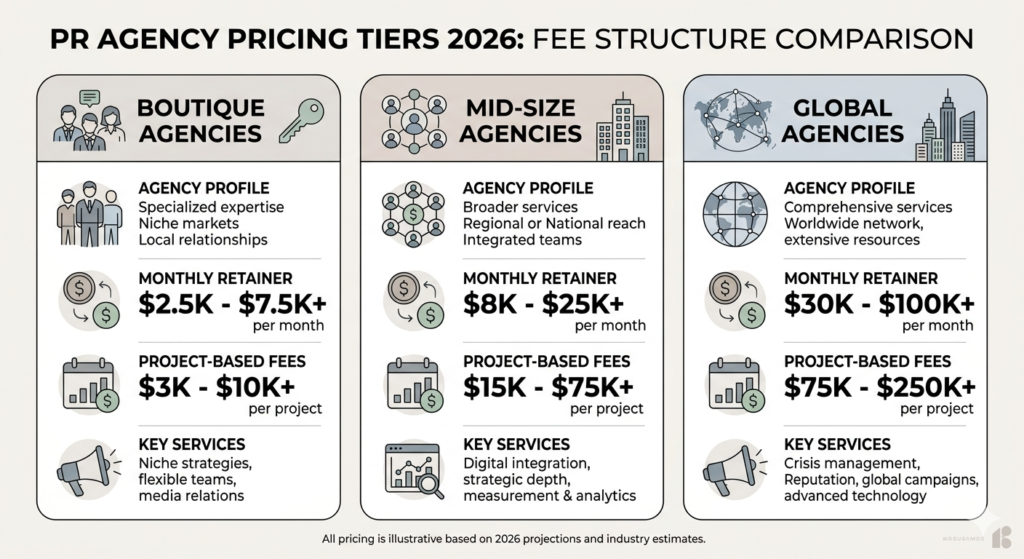
Prompt:
“A clean, modern infographic showing PR agency pricing tiers for 2026, with three columns labeled boutique, mid-size, and global agencies, including price ranges, minimalist design, neutral colors, and professional marketing style.”
Alt Text:
PR agency pricing tiers infographic showing boutique, mid-size, and global agency costs in 2026
The 3 Main PR Agency Pricing Models
Before you ask how much PR costs, you need to understand how agencies structure their fees. There are three models you will come across.
1. Monthly Retainer: The Most Common PR Agency Pricing Model
Most agencies charge a fixed monthly fee for ongoing work.
That covers media outreach, strategy, press release writing, reporting, and relationship development.
Retainers suit PR well because the discipline rewards consistency, steady engagement over months typically delivers far better results than short, intense bursts of activity.
Furthermore, a retainer also gives the agency time to understand your brand deeply, which leads to sharper pitching and higher-quality media placements over time.
2. Project-Based PR Pricing
Project fees, by contrast, cover time-limited campaigns, a product launch, funding announcement, or rebrand.
Because the work is concentrated into a shorter window, project fees tend to run higher per month than retainers.
They give you flexibility if you need focused PR support for a specific moment rather than an ongoing programme.
3. Hourly Consulting Rates
Some senior PR professionals charge by the hour for advisory work, strategy sessions, or communication audits.
This model is less common for full campaign execution, but it works well if you need expert input without committing to a full engagement.
Senior consultants typically charge between $200 and $500 per hour.
Increasingly, more agencies now blend models, for example, pairing a lower monthly retainer with a performance component, or offering a short consulting phase before moving into execution.
These hybrid arrangements reflect client demand for both flexibility and accountability.
Realistic Prices For PR Agencies In 2026
So how much does PR really cost in 2026? Here is a realistic list based on current prices instead of agency sales pitches.
1. Small and Boutique Agencies Retainers per month: $3,500 – $8,000 Fees per project: $8,000 – $20,000, perfect for startups and niche companies
Especially, where the target media audience is narrow, leaving time for other work by a smaller team.
2. Medium-Sized Agencies Retainers per month: $8,000 – $20,000 Fees per project: $15,000 – $40,000 Ideal for growing companies that have outgrown their current level of PR .
And as a result, they are now ready for industry or national coverage.
3. Large and Global Agencies Retainers per month: $20,000 – $50,000+ Fees per project: $30,000 – $100,000+ Suitable for global businesses with needs for multi-market media coverage.
Also, dedicated teams in different areas around the world.
Most companies land somewhere between $5,000 and $15,000 per month.
That said, PR agency pricing shifts based on your industry, geographic scope, and how complex the campaign is.
A higher price tag does not automatically mean better results, a very low budget, on the other hand, usually means limited senior involvement and slower momentum.
What Is Actually Included in PR Agency Fees
A PR pricing guide for 2026 would not be complete without explaining what sits inside a typical retainer. The following are standard offerings in most PR agencies:
- Media outreach and pitching to journalists: finding suitable reporters, developing tailored pitches, and pursuing the process until the story is placed or dead
- Writing press releases and distributing them: crafting news statements and reaching the correct editors either directly or through wire services
- Thought leadership: developing thought leaders within your organization through writing articles, providing expert opinion, and participating in conferences
- Digital PR: establishing an online presence through coverage that enhances your company’s search engine optimization and domain authority
- Monthly reporting: monitoring media mentions, measuring share of voice, gauging public sentiment, and evaluating performance metrics for the campaign
A good fact to be aware of here is that agencies do not promise results; they sell effort and strategy.
Therefore, deliverables will often be activities completed, such as number of pitches made or stories submitted.
Hidden Costs That Do Not Always Show Up in the Proposal
The fee structure for PR agencies may seem relatively straightforward at first glance.
However, there are other expenses that can arise fairly rapidly if you do not ask all the necessary questions beforehand:
- Press distribution costs: The cost of sending out press releases via wire news services can vary widely, starting from a few hundred to even thousands of dollars per press release
- Media database access fees: Some agencies charge for using services like Cision or Muck Rack rather than covering these costs themselves
- Influencer marketing and amplification budget:
If your campaign requires more exposure, you may have to invest in paid advertising in addition to earned media - Advertising disguised as earned media: Some agencies may offer paid advertising under the guise of earned media without disclosing this to you
- Additional scope creep fees: Any additional work performed beyond the initial brief will come at an additional cost
With that in mind, ask agencies to list any potential out-of-pocket costs separately from their core PR agency pricing.
If they are reluctant to do this, take note, transparency here is usually a good indicator of how the relationship will go.

Prompt:
“A business professional reviewing a PR agency proposal on a laptop, with charts, pricing tables, and documents on a desk, natural lighting, modern office environment, realistic style”
Alt Text:
Business professional reviewing PR agency pricing proposal and marketing budget documents
What Drives PR Agency Pricing Up or Down
PR agency pricing is rarely arbitrary. In fact, a few core factors typically determine where your costs land.
Industry and Competition
Sectors like technology, finance, and healthcare are crowded with brands competing for the same journalist attention.
More competition means more effort, which in turn pushes PR costs higher than in quieter, more niche markets.
Geographic Scope
A campaign targeting one city is far less complex than a multi-market international rollout. Global campaigns require bigger teams, wider media contact networks, and significantly more coordination.
As a result, geographic scope is one of the biggest levers on PR agency fees.
Senior Access and Team Experience
Junior account teams cost less, but consistent access to a senior PR director or partner comes at a premium.
Boutique agencies sometimes offer more senior involvement at lower price points than larger firms, so comparing carefully across agency types is worth your time.
Campaign Complexity
A single product launch differs significantly from a multi-stakeholder crisis communication strategy.
Campaigns that span multiple markets, languages, or media types increase both the effort required and the cost.
Accordingly, discuss scope clearly with any agency before agreeing on pricing.
Retainer vs Project: Which PR Agency Pricing Model Fits Your Situation
This is usually one of the first decisions you face. Both options have clear advantages depending on what you are trying to accomplish.
If you want a retainer then:
- You need sustained brand awareness built throughout several months or years
- You require ongoing relationship development with journalists from your sector
- You are focused on building credibility over time, not just a one-off mention
If you opt for project-based work then:
- You have a specific event, product launch or press release to boost right now
- You wish to test out a potential agency before making any commitment
- You operate with a finite short-term budget and a deadline
Overall, retention arrangements will likely prove more cost-effective due to the fact that the agency can build up momentum.
However, a project-based approach is a sound choice when you have no prior experience of working with an outside PR firm.
Budgeting for PR Across All Phases of Business Development
The amount of money you need for PR should depend on your level of development. The following budget guide will help you get started in 2026:
- Startup stage: $3,000 – $8,000 per month: Focus on building early awareness and credibility with the publications your target audience actually reads
- Growth stage: $8,000 – $20,000 per month: Scale visibility across industry and national media, supported by a team with broader capacity
- Enterprise stage: $20,000+ per month: Focus on global positioning, thought leadership at scale, and proactive reputation management
At any stage, plan for a minimum commitment of three to six months. Short-term PR rarely moves the needle.
The longer you stay consistent, the more momentum compounds, and the stronger each individual pitch becomes because journalists already recognise your brand.
Issues To Watch for When Reviewing PR Agency Fees
Not every agency prices fairly or operates with the transparency you deserve. Therefore, keep an eye out for these warning signs:
- Guaranteed media placements: No credible agency can promise a specific placement. If they do, treat it as a dealbreaker
- Vague deliverables: You should always know exactly what activities the agency will carry out each month, not just a general description of “media outreach”
- No reporting structure: Good agencies tell you regularly what they have done and what it has produced
- Shifting or unclear pricing: Overly complicated fee structures that change during negotiations suggest poor organisation at best and a bait-and-switch at worst
- All junior team members: Ask directly who manages your account day to day and how much time a senior strategist spends on your work
Where possible, request a short pilot programme, one to three months, before committing to a longer contract.
This gives you enough time to see how the agency works, how they communicate, and whether the chemistry is there before you go all in on PR agency pricing at scale.
Where PR Agency Pricing Is Headed Beyond 2026
The pricing models in PR agency will continue to adapt as media environment changes and the requirements from clients become stricter.
Several tendencies already contribute to shaping these prices and the way they evolve:
- Performance-based compensation: Some companies are adopting a practice where their remuneration is partially connected to performance metrics such as increased share of voice, higher domain authority, etc.
- Integration with SEO/content marketing: PR specialists start collaborating with SEO and content teams within agencies and prices reflect the extended service scope
- Utilization of artificial intelligence: Artificial intelligence is used for pitch researching, media monitoring, and reporting purposes but strategy formulation and human relations continue playing a key role.
PR services cannot become significantly cheaper due to the utilization of AI in the short-term future - Increased level of accountability: Today, most clients require analytical reports supported by metrics that make it necessary for agencies to use analytics software and establish a process framework
Taken together, the direction of travel is clear: more accountability, more measurability, but not necessarily lower costs.
Agencies that can demonstrate clear ROI will hold their rates. Clients who understand this will be far better placed to choose the right partner.

Prompt:
“A conceptual image of public relations strategy, with media icons, journalists, press releases, and digital connections surrounding a central brand, futuristic but clean design”
Alt Text:
Public relations strategy illustration showing media outreach, press coverage, and brand positioning
Conclusion on PR Agency Pricing in 2026
PR agency pricing is one of the more variable line items in any marketing budget, but it does not need to feel like a black box.
Once you understand the pricing models, know what drives costs up or down, and can spot the warning signs of a bad deal, you are in a much stronger position to make a decision you are confident in.
The single most important thing to take away from this guide: PR is a long game.
Coverage rarely happens overnight.
The brands that get the best results from their PR agency fees are the ones that commit to a consistent, well-resourced programme over time, not the ones that try it for six weeks and wonder why nothing has moved.
If you are actively evaluating agencies right now, start by requesting three things: a clear scope of work, a full breakdown of PR agency fees including any additional costs, and a sample of their monthly reporting.
Those three documents will tell you more about an agency than any credentials deck or case study ever will.
Use the benchmarks in this PR pricing guide for 2026 to set a realistic budget, shortlist the right agencies for your stage of growth, and start building the kind of media presence that compounds over time.