
Geopolitical PR risk has forever changed the landscape in which multinational brands communicate, compete, and survive.
In the period between 2022 and 2026 alone, over one thousand multinational corporations altered their structure or left markets due to geopolitical risk events.
.Some organizations suffer irreparable reputational damage because their PR departments are caught off guard.
This article gives PR leaders and CMOs a bold framework to protect reputation before the next crisis strikes.
The concept of neutrality in corporations is no longer relevant. The expectations of stakeholders have changed dramatically and forever.
Consumers, employees, and even investors now insist that corporations demonstrate values-based positioning, and call out those that do not.
The end of the binary between politics and business has created a new world in which all decisions have communicative consequences.
If you do not have a structured approach to this threat, you are already in danger in ways that your leadership may not even fully comprehend.
Geopolitical PR Risk Is Now a Board-Level Strategic Priority
For decades, the business world operated under a comfortable assumption: commerce and politics do not mix.
That assumption collapsed decisively after 2022. Following the invasion of Ukraine, corporations moved quickly to declare market exits, while audiences read any silence as complicity.
Harvard Business Review in 2023 found that firms delaying statements during the Ukraine crisis saw 30–40% sharper trust drops than those that communicated early.
Meanwhile, Edelman’s 2023–2025 data confirms that 62–64% of consumers globally expect CEOs to speak out during major geopolitical crises. PwC further establishes that 76% of executives now directly link geopolitical instability to brand trust risk.
Therefore, geopolitical PR risk is no longer a communications footnote; it is a strategic imperative that demands investment and executive ownership.
The conventional crisis PR approach is ineffective in the context of geopolitics because these approaches are based on assumptions of a single market, and a homogeneous audience.
In contrast, geopolitical crises involve many nations, many values, and an enduring crisis situation.
Organizations need to adopt a new operating model that emphasizes foresight, cultural awareness, and rapid decision-making authority.
Related: PR Crisis Management: How to Turn a PR Crisis Into a Success Story

The Speed Problem in Geopolitical PR Risk Management
According to the World Economic Forum (2024), “False information can spread six times faster than fact-based information released by companies in an international crisis situation.”
The issue of speed is one of the most important factors associated with PR risk in geopolitics.
Companies that delay their response until they have all the information available to them essentially put their fate in the hands of activists and negative media in a matter of hours.
Being ready is the only logical solution in this scenario, but this is an exponentially more complicated problem because of polarized navigation in fractured media.
Understanding the Stakeholder Minefield of Geopolitical PR Risk
What pleases one audience tends to alienate another.
Polarized navigation is not a metaphor; it is the reality of the operational environment for PR teams that are responsible for global brands .
Gallup (2024) reported that 48% of employees expect employers to take a stance that is consistent with their values during global crises.
In 2024, BlackRock confirmed that ESG risk disclosures now explicitly mention geopolitical risk.
As a result, failure to mitigate this risk compounds exposure in ways few other risks can match.
Geopolitical PR risk exposes brands to a complex web of competing stakeholder demands.
Key Stakeholders Driving Geopolitical PR Risk Exposure
- Divergent national policies fuel a growing gap between compliance and public perception for governments and regulators. Secondary cycles of backlash on social media emerge in response to sanctions, transforming supply chain choices into moral stories.
- Customers and activists: Consumers are increasingly making purchasing choices based on foreign policy positions. Brands are now forced to address cancel culture mitigation as a key concern on the front lines.
- Investors and ESG monitors: Geopolitical risk is now included in formal risk disclosures. The financial impact of reputational failure has never been more precisely measurable.
- Employees: Internal communications are now regularly leaked to the outside world. Poor internal alignment causes employee complaints to become public reputational incidents.
Five Bold Tactics to Manage Geopolitical PR Risk Before Crisis Strikes
The following five tactics represent the cutting edge of geopolitical PR risk management.
They are proactive, values-based, and resilient in the face of the speed and complexity of contemporary geopolitical crises. Each of these tactics relies on the others, and together, they represent a comprehensive reputation defense strategy.
1. Preemptive Narrative Positioning Against Geopolitical PR Risk
The most effective way to mitigate geopolitical PR risk is for brands to take action before the crisis even occurs. Preemptive narrative positioning involves a comprehensive risk assessment for exposure on three key fronts:
- Countries of operation: analyzing political affinity, government type, risk of conflict, and freedom of the press
- Supply chain nodes: assessing links to countries under sanction or geographies near conflict zones
- Political flashpoints: tracking election cycles, legislative developments, and political tensions of relevance to the brand’s industry
Once the sensitivities are understood with precision, the brands create red line frameworks, which are internal organizational guidelines on what to communicate and what not to communicate.
Communication of values-based policies in advance of situations requiring statements is the hallmark of geopolitical PR risk leadership.
Cultural sensitivity must be the guiding principle behind the localization of such values-based policies in culturally and politically diverse markets.
2. Values-Based Communication That Avoids Activism Traps
Values-based positioning of the brand is the key to avoiding geopolitical PR risks; however, it must be done with precision.
Brands must avoid the activism trap of using values-based rhetoric but failing to execute it internally.
Legal compliance, which helps to eliminate the perception of political bias and provide a rationale for decisions
Prioritize impact over ideology; positioning brands on results yields better success in politically diverse markets.
This model allows for a cohesive worldwide response in a politically divergent environment without alienating markets with differing sensibilities.
Build geopolitical PR risk communication on cultural sensitivity; it is a foundation, not an add-on.
3. Scenario-Driven Crisis Playbooks for Geopolitical PR Risk
The Core Scenarios Every Geopolitical PR Risk Playbook Must Include
1. Sanctions scenario: What the brand communicates to customers, employees, and investors within the first 24 hours of a new sanctions announcement
2. Civil unrest Scenario: How the brand protects employees on the ground while maintaining consistent positioning in the face of civil unrest in global markets
3. Diplomatic rupture scenario: How the brand navigates the disruption to operations and the pressure on reputation when two markets are in formal diplomatic conflict
The playbooks must also address the challenge of polarized navigation, balancing the imperative of maintaining brand neutrality at the macro level with the need to accommodate the nuances of regional variations.
A coherent global response and an astute local execution are not mutually exclusive; they are complementary requirements in the art of geopolitical PR risk management.
4. Internal Diplomacy Through Strategic Communications
Organizations often overlook internal alignment, yet employee communications during geopolitical crises inevitably join public discourse.
Companies that seek to suppress internal dissent rather than engage it in an honest fashion are actually increasing geopolitical PR risk.
This is because they are inadvertently creating an environment in which whistleblower-style disclosures will occur.
Some best practices in internal communications during geopolitical crises are:
1. Conducting weekly cross-functional geopolitical briefings to ensure the PR, HR, legal, and finance functions are all working from the same information set before external communications are released
2. Creating an environment in which employee questions are encouraged through open forums to ensure a sense of organizational values in which honest dialogue is encouraged .
3. Conducting executive alignment sessions to ensure a unified voice in external communications, stakeholder expectations become fragmented in real time and create a secondary crisis
When internal communications are in alignment with external values-based positioning, geopolitical PR risk is effectively managed.
The employee becomes a participant in maintaining organizational reputation rather than a threat to it.

5. Media Strategy for a Polarized and Fragmented World
Media strategy is the core element in the successful management of geopolitical PR risk in a fragmented media space.
Brands that allow activist or hostile media narratives to frame their intent are giving up control, and regaining control is extremely difficult once it is lost.
Synthetic propaganda targeting brand symbols adds a new sense of urgency to the media positioning imperative.
Effective Media Strategy for a Geopolitical Space
- Platform selection with intent, rather than ideological echo chambers that exacerbate the polarized brand navigation issues inherent in the geopolitical space
- Journalist briefings based on data and policy, rather than providing context through commentary to avoid misquotation and position the brand as a credible, informed voice
- Narrative capture strategies, proactively pushing brand-approved narratives in front of hostile media to own the narrative
- Cancel culture mitigation is not about avoiding brand controversy; it is about owning your own moral narrative before your critics do
- Organizations that integrate media relations into their geopolitical PR risk strategies outperform their reactive counterparts in every brand reputation metric imaginable.
Geopolitical PR Risk and the ESG Imperative
ESG accountability and Geopolitical PR risk are now two sides of the same coin.
Human rights, labor practices, and geography are now triggering foreign policy actions from governments, investors, and civil society organizations all at once.
The key operating principle here is values-action consistency.
This means cultural sensitivity must not only be reflected in brand messaging but also in the operational decisions a brand makes on where it manufactures.
If a brand’s operating geography does not align with its human rights values, then its geopolitical PR risk is existential rather than manageable.
Sophisticated investors are now tracking this gap for their portfolio holdings, and ESG organizations are disclosing this gap in their public reports.
Therefore, a brand’s geopolitical PR risk strategy must now include its ESG leadership in a unified risk management function.
This is not a futuristic goal in 2026 but a current operating expectation from institutional investors, governments, and consumers alike.
Measuring and Monitoring Geopolitical PR Risk With Precision
However, effective geopolitical PR risk management requires measurable indicators, as you cannot prepare for what you cannot measure.
This is where monitoring quantitative indicators and qualitative intelligence comes into play, which is done in three interlocking layers.
Early Warning Indicators for Geopolitical PR Risk
1. Election cycles within operating markets, especially in markets where policy can change quickly
2. Legislative trends in sanctions, trade barriers, and nationalization
3. Changes in social sentiment regarding geopolitical brand concerns, which can be monitored via AI-powered listening tools
4. Troop movements and diplomatic collapses in proximity to supply chain nodes
KPIs for Tracking Brand Exposure
- Response Time: Time to elapse between geopolitical incident and first approved public statement
- Trust Delta: Pre- and post-crisis trust scores for the brand, segmented by market
- Narrative Dominance: Percentage of media coverage that uses approved brand messaging instead of activist or negative messaging
- Stress Testing Reputation: Allows PR leaders to calculate geopolitical PR risk exposure and present the case to the board before they are forced to act under duress.
Common Failures That Amplify Geopolitical PR Risk Exposure
Knowing what not to do is as important as knowing what to do.
The right governance identifies and avoids predictable patterns behind the worst geopolitical PR risk failures.
1. Delayed statements: Reactive communications come across as deceptive and accelerate loss of trust quickly.
.Stakeholders establish trust expectations early; hours of silence imply your complicity or incompetence
2. Over-politicization: Speaking in activist speak without operational alignment establishes brand neutrality violations that come across as performative rather than authentic, accelerating cancel culture attacks.
3. Empty virtue signaling: making symbolic gestures without changing policies is attacked more aggressively than silence. The audience in 2026 expects to see action, not just speak to alignment.
4.Over-lawyered statements: Relying on lawyers alone creates cold, defensive messaging that kills empathy during a crisis.
5. Isolated national messaging: Failing to coordinate regional communications creates contradictory stories and signals internal turmoil to sophisticated viewers.
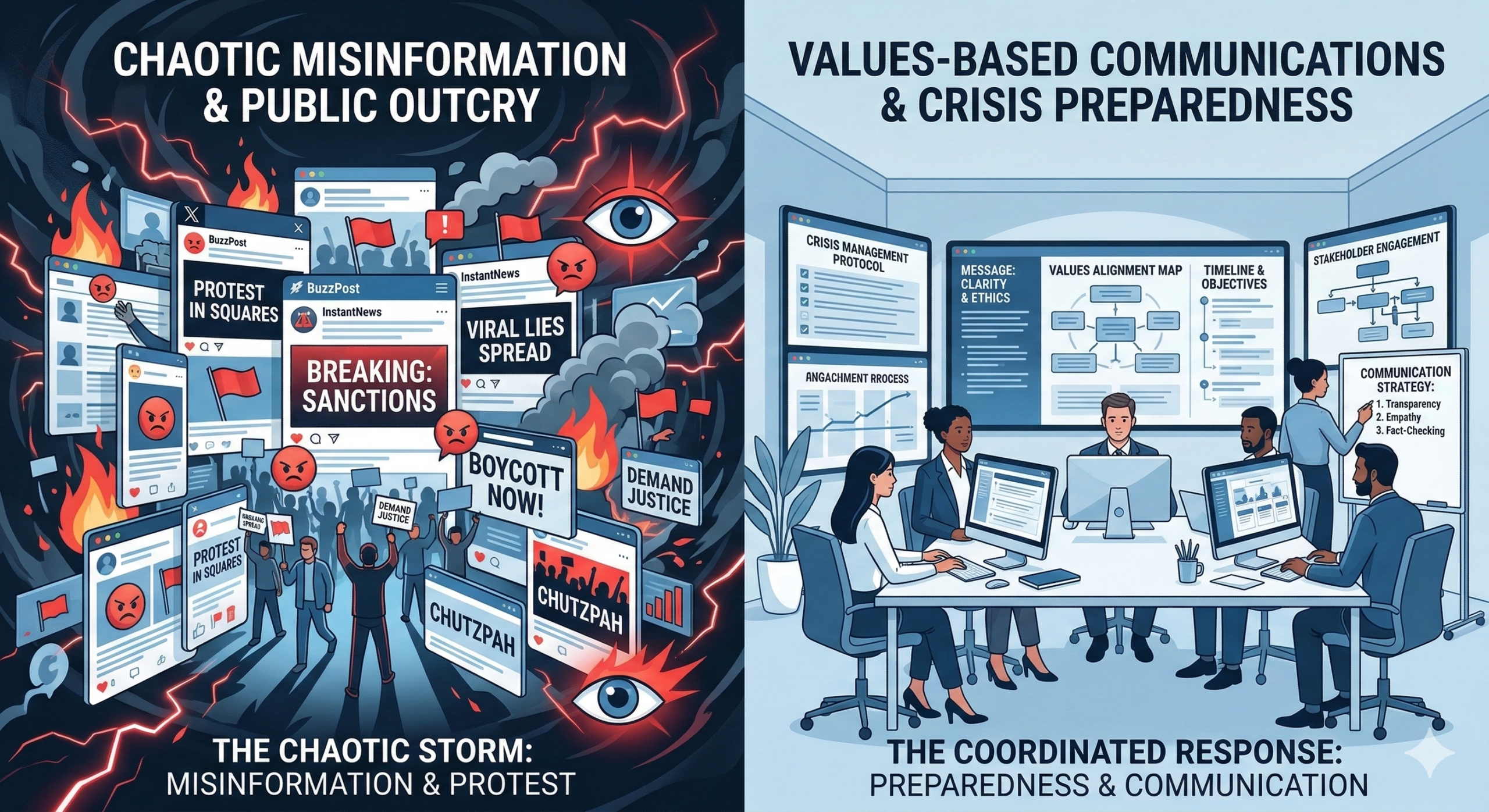
Conclusion: Reputation Is the New Foreign Policy in an Age of Geopolitical PR Risk
Multinational brands are now non-state actors, caught in the thick of diplomatic tensions.
Multiple stakeholder demands and moral imperatives with every public decision.
Geopolitical PR risks are not a PR problem that can be solved by a PR solution; they are a strategic leadership imperative that must be treated with the same analytical depth as financial planning .
The five bold tactics outlined in this article, preemptive narrative positioning, values-based communication, scenario-driven playbooks, internal diplomacy, and polarized media strategy,
Thus, provide PR leaders with a holistic framework for managing geopolitical brand risks before they become crises.
With ESG integration, robust metrics, and cross-border governance, this solution can keep pace with organizational scale and complexity.
The cost of inaction for geopolitical PR risk grows exponentially beyond any regulatory fine.
Trust, once broken during a geopolitical crisis, takes years and substantial investment to rebuild.
Thus, it is those organizations that invest in foresight and crisis preparation today that will determine the next era of global brand leadership.
Start here: Audit your exposure, align your stakeholders, and assert your principles before the world forces your hand.
If considering how to improve your brand’s geopolitical resilience, use this framework as your starting point.
Managing geopolitical PR risk proactively represents the most obvious competitive advantage available to global brands in 2026.