
The reputation of a corporation is no longer an issue of the boardroom. Today, the key to a successful ESG communications strategy is to ensure that your investors, employees,
customers, and communities view your organization in the right way. However, many organizations still view ESG as a compliance issue rather than a communication opportunity.
The consequence is that many organizations are missing out on stakeholder wins, undermining trust, and increasing vulnerability to reputational risk.
This article will explore how to develop an ESG communications strategy that delivers tangible results, ranging from increased investor confidence to enhanced employee engagement, and why it has never been more important to get it right.
Why an ESG Communications Strategy Now Defines Corporate Reputation
Silence is no longer an option. Organizations that do not communicate their commitments on environmental, social, and governance issues are left with a void that is filled with suspicion by stakeholders.
A successful ESG communications strategy goes beyond the annual report and engages in a continuous narrative process.
Research has repeatedly demonstrated that ESG-related media events influence shareholder value.
Social media sentiment trends that are driven by environmental or governance scandals can be quantified and understood as reputational risk.
At the same time, companies that focus on proactive ESG storytelling create reputational capital that can mitigate risk much more effectively.
But high-performance data alone will never be sufficient. Without a communication strategy, even the most outstanding ESG performance will remain invisible.
As such, savvy companies today recognize that their ESG communications strategy is essential infrastructure, not an add-on.
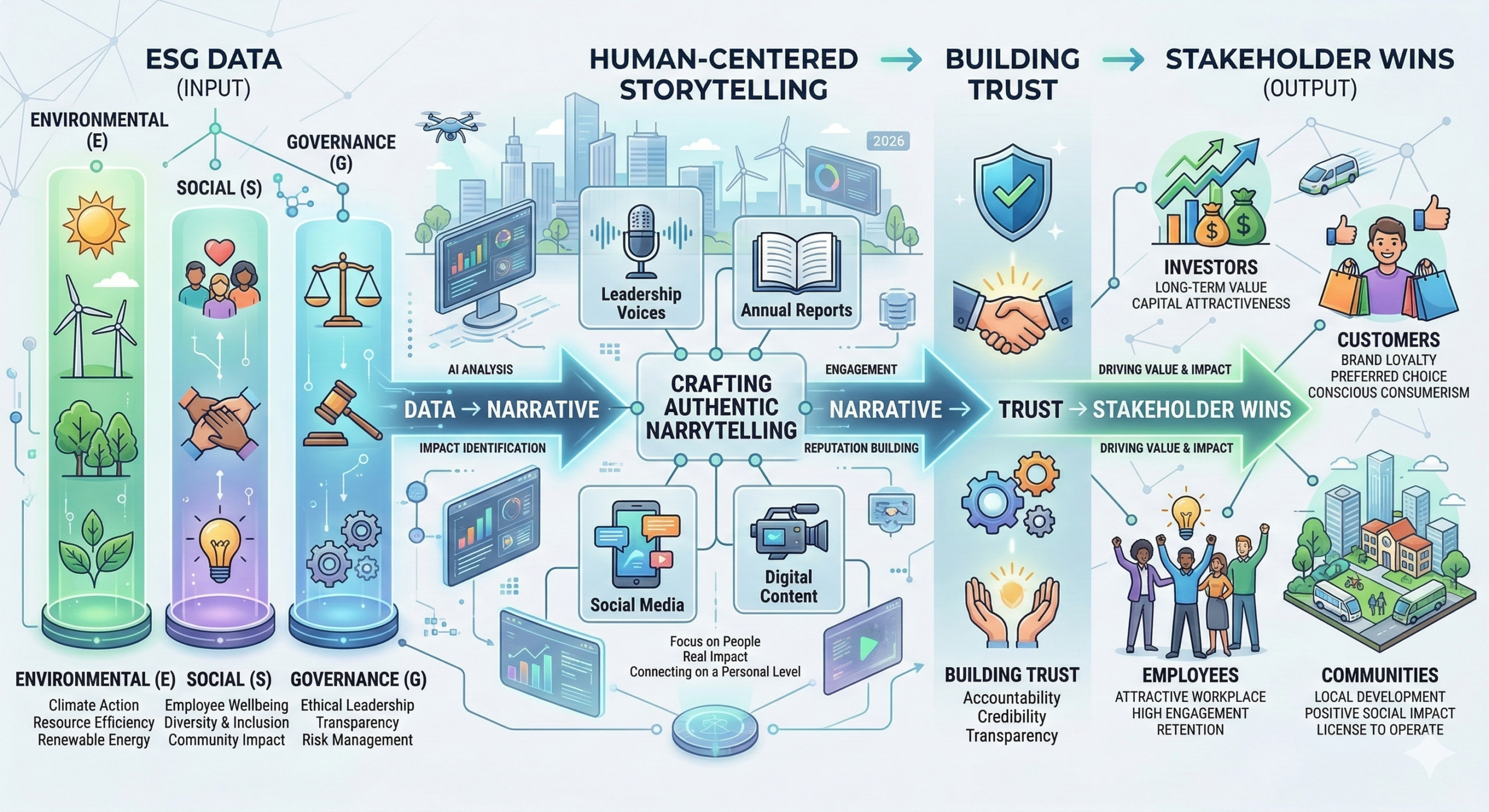
The Evolution from ESG Reporting to ESG Storytelling
The traditional ESG report was centered on compliance and data sharing.
But the ESG Communications Strategy of 2026 requires something much more exciting. Companies need to convert data into human stories, which not only describe what was accomplished but also explain why it matters and to whom.
For instance, good environmental storytelling connects lower carbon emissions to improved community health outcomes and climate resilience.
This type of storytelling will resonate with stakeholders far beyond the investor base. It builds emotional connection, which is the foundation of genuine stakeholder trust.
Understanding Your Stakeholder Map: Who Your ESG Communications Strategy Must Reach
One ESG message will not fit all. Each stakeholder group receives ESG information differently and needs a different ESG narrative. So, your ESG Communications Strategy should begin with a stakeholder map.
Key Stakeholder Groups and What They Need from ESG Information
- Investors and analysts: They require ESG stories aligned with financial performance, risk management, and business strategy. Digital dashboards and ESG reporting frameworks facilitate investment-grade ESG communications.
- Customers and consumers: They respond to ESG stories about human impact, not statistics. Purpose-driven branding with ESG stories about human impact can increase customer loyalty and differentiate your brand.
- Employees and talent: ESG stories can increase employee pride and improve recruitment success. Diversity, equity, and inclusion communications can have a particularly strong impact.
- Regulators and policymakers: They require evidence, compliance validation, and ESG impact reporting aligned with regulatory requirements like the EU CSRD.
- Media and civil society: Credible communication enables accurate media reporting. Poor communication, meanwhile, amplifies reputational risk and invites criticism.
- Local communities and NGOs: Localized ESG stories and co-created community initiatives deepen legitimacy and reduce skepticism far more effectively than globalized claims.
Moreover, stakeholder engagement is therefore not a single-channel activity. It requires tailored narratives across every touchpoint, shaped by what each audience values most.
A CSR PR approach that worked five years ago, focused on philanthropy and brand visibility, must now evolve into integrated ESG communication built on evidence and authentic dialogue.
Core Principles of a High-Performing ESG Communications Strategy
Building the ESG Narrative: From Data to Human Story
At the heart of every powerful ESG communications strategy lies the ability to transform complex ESG metrics into compelling, human-centered stories. Data provides credibility. Story creates connection. Combined, they drive stakeholder action.
1. ESG Narrative Audit
As you prepare to craft your ESG narrative, ask yourself these five questions:
- Can you tie each ESG statement to an actual data point?
- Do your ESG statements vary significantly across investor, employee, and customer audiences?
- Has your ESG positioning statement been vetted by both legal and sustainability professionals?
- Can you demonstrate actual progress in each ESG area?
- Would an unbiased journalist be able to write about your ESG narrative without any guidance?
- If you answered no to any of these questions, you need to address these gaps before you publish.
How to Craft Your Core ESG Positioning Statement
Your ESG positioning statement serves as the backbone of all communication.
It must answer three questions: What do you stand for? What are you doing about it? And what difference does it make?
This statement grounds your ESG Communications Strategy in purpose-driven branding that feels authentic rather than performative.
Moreover, your ESG narrative must align explicitly with corporate strategy. When ESG communication feels integrated, rather than bolted on stakeholders respond with greater trust.
They recognize the difference between an organization that lives its values and one that merely markets them.
Environmental Storytelling That Moves Stakeholders
Environmental storytelling is one of the most compelling tools in your ESG Communications Strategy toolkit.
Instead of communicating tonnes of CO₂ reduced in a vacuum, link those reductions to what they mean: cleaner air in partner communities, thriving ecosystems, or mitigated supply chain risks.
This type of storytelling makes ESG information emotionally engaging and relevant.
DEI Comms: The Social Pillar That Builds Internal and External Trust
DEI communication is a critical component of the social pillar of your ESG Communications Strategy. But DEI communication is also fraught with danger.
Overhyping diversity successes without hard evidence is a recipe for criticism and blowback.
Instead, communicate progress made, including setbacks, and let the people impacted by your DEI initiatives have a voice.
Authentic storytelling from employees and communities will build more trust than slick corporate messaging.
Channel Strategy: Where Your ESG Communications Strategy Should Live
Stakeholders engage with ESG information across a variety of touchpoints. Thus, your ESG Communications Strategy has to engage stakeholders across a complete channel ecosystem, not just annual report disclosures.
- Owned media: Corporate sites, sustainability microsites, and annual reports comprise the basic disclosure platform.
- Earned media: ESG journalism and industry media outreach increase credibility for your ESG messages.
- Executive engagement: Statements from executives, speeches from executives, and interviews featuring executives communicate organizational commitment to stakeholders.
- Internal comms: Educating employees and communicating through town hall meetings embeds ESG into organizational culture.
- Digital media: Interactive ESG dashboards, social media sites, and video content platforms engage broader stakeholders.
In addition, your ESG Communications Strategy has to leverage each channel effectively, adjusting content and level of detail according to audience expectations while keeping core messaging consistent.
Do your stakeholders, investors, customers, employees, or regulators expect anything else from your ESG communications strategy?

Greenwashing Avoidance: Protecting Your ESG Communications Strategy from Its Greatest Risk
Avoiding greenwashing is not a compliance issue but a survival issue.
The audience in 2026 is more sophisticated and has the tools to identify any discrepancies between the corporate ESG statements and actual performance.
Moreover, as soon as the gap is identified, trust is lost, and it takes time and money to regain.
Typical Greenwashing Pitfalls Your ESG Communications Strategy Should Avoid
- Claiming success without third-party verification.
- Using generic terms such as ‘sustainable,’ ‘eco-friendly,’ or ‘responsible’ without concrete evidence.
- Reporting impact with success stories while ignoring failures or limitations.
- Making ESG commitments for the future without a clear plan, timeline, or governance structure.
- Inconsistent ESG storytelling with actual business activities, investments, or supply chain practices.
The force of regulatory compliance makes this risk even more challenging. The EU Corporate Sustainability Reporting Directive (CSRD) requires robust and verifiable reporting.
Thus, your ESG Communications Strategy should ensure your communications team acts as a moral gatekeeper, scrutinizing all claims before release.
The communications function must also work closely with legal, sustainability, and finance teams to ensure that CSR PR output is fully aligned with audited ESG performance data.
Additionally, Siloed communications create liability. Integrated communication creates credibility.
Failure Case Study
The effects of such failure have been well-documented. H&M’s Conscious Collection was thrust into the spotlight after it was discovered that the sustainability scorecards used to market their products were not only misleading but also lacked methodological rigor.
The result was a product recall and a spotlight on the fashion industry as a whole. The message is clear: one misstep in ESG claims vs. ESG reality can undo years of narrative credibility.
Case Patterns: What Leading ESG Communications Strategies Do Differently
Organizations that consistently win big with their ESG communications strategy share four common patterns. These are not hypothetical but rather based on real-life corporate communication practices.
1. They Lead with Actions, Not Slogans
The best ESG communications strategy leads with actions rather than slogans or empty promises. A notable example is Bunge’s employee sustainability challenge, which connected its corporate ESG reporting with employee actions, demonstrating that its ESG efforts are not just for senior leadership but for the entire organization.
2. They Empower Credible Voices
Another example is Unilever, which incorporates credible voices from its business units, partner communities, and even its supply chain into its ESG narrative. This type of practice strengthens their stakeholder engagement practice since it makes their ESG communications look diverse, accountable, and authentic instead of controlled.
3. They Communicate Progress, Not Just Success
Finally, ESG communication successes share their progress, not just their success stories. This makes their ESG communications strategy stronger since it shows their accountability and their ability to avoid greenwashing.
4. They Integrate ESG Into Leadership Identity
Senior leadership visibility in ESG communication signals sustained organizational commitment. When executives own the narrative through keynote speeches, media appearances, and public commitments, it reinforces that the ESG Communications Strategy operates at the highest strategic level, not just in the sustainability department.
Measuring the Impact of Your ESG Communications Strategy
To measure the success of your ESG Communications Strategy, you need to set up metrics that extend beyond the number of impressions and media coverage.
The following metrics will give you more nuanced and valuable information:
- Trust indices among stakeholders: Measure changes in trust levels among investors, employees, and customers through annual surveys and feedback channels.
- Sentiment analysis: Measure media and social media sentiment on ESG issues to identify early warnings of reputational risk or positive stakeholder engagement.
- Stakeholder perception tracking: Track the impact of your ESG Communications Strategy through perception surveys conducted annually or bi-annually.
- Regulatory alignment metrics: Track the success of your ESG reporting and storytelling in meeting framework and regulatory requirements.
- Internal engagement metrics: Track the level of internal buy-in and advocacy for your ESG story, an important metric in DEI communications success.
The above sources of data can be used to make improvements in an iterative manner. A good ESG communications strategy is never static but constantly evolving in response to stakeholder perception, regulatory changes, and organizational performance changes.
Measurement is therefore not just about measuring past success but about forward planning.
The Future of ESG Communications Strategy: What Leaders Must Prepare For
The ESG Communications environment will continue to change at an accelerated pace. Three drivers will influence the direction of the ESG Communications Strategies of the future. They are:
Activist Investors and Informed Consumers Will Demand More
Vague purpose-driven brand positioning will increasingly face challenges from activist investors and more ESG-savvy consumers. Organizations will need to develop ESG communications strategies that are resilient enough to face public challenges from all fronts at once.
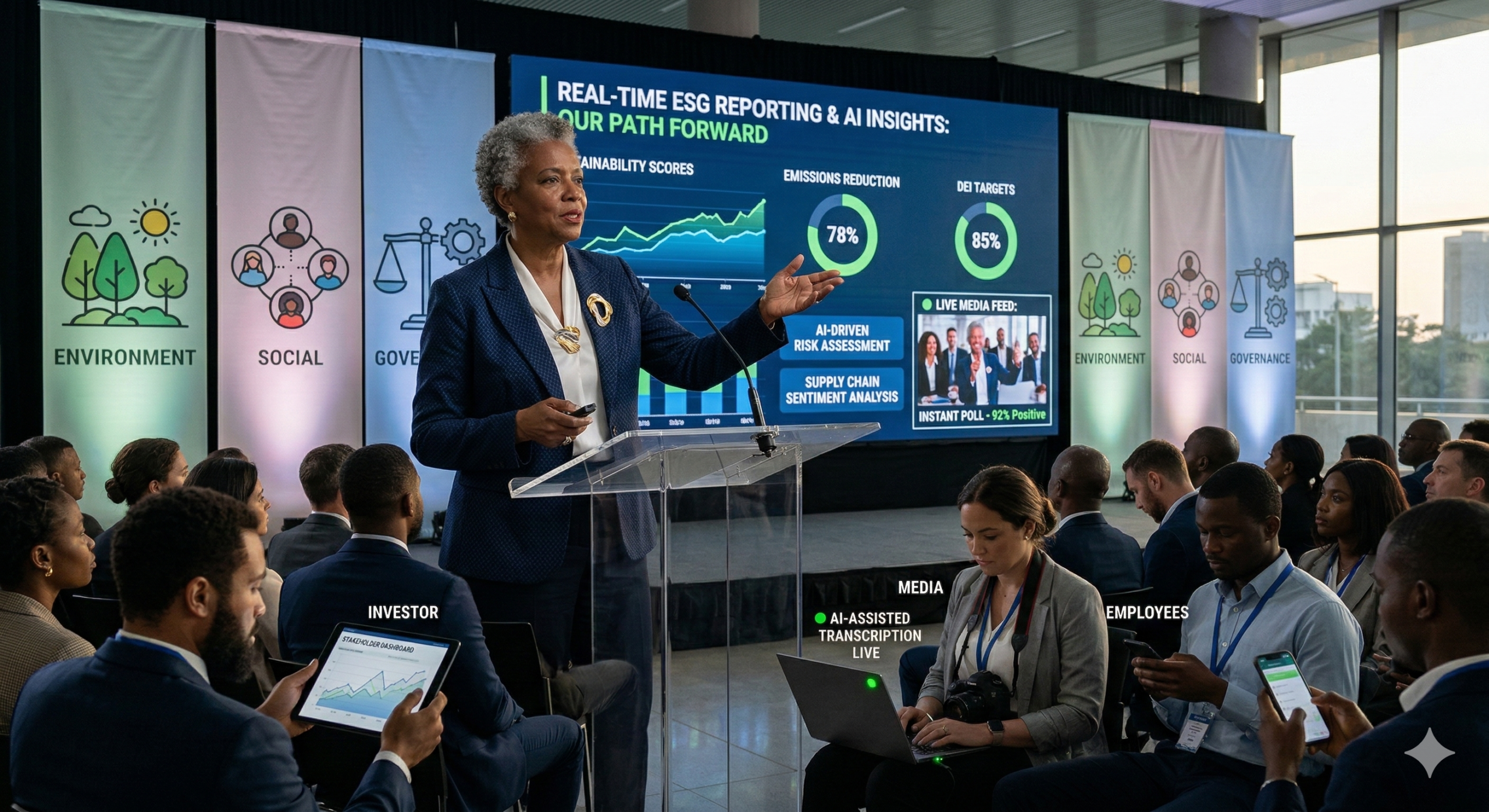
AI and Real-Time ESG Reporting Will Transform Transparency
New AI technologies will make it possible to report ESG impacts in real time. Organizations that are able to add this into their ESG communications strategies will gain a competitive advantage over others.
Regulatory Expectations Will Tighten Further
Regulations related to ESG will continue to grow globally. An effective ESG communications strategy will need to consider regulatory requirements, not just react to them.
Additionally, This will not only reduce the risk of non-compliance but will also demonstrate to stakeholders that you are a leader, not a follower.
Regulatory Timeline
The window for regulation is closing faster than many firms are aware of. The EU’s CSRD has commenced phased enforcement in 2024, with smaller firms included in 2028.
The ISSB’s international sustainability disclosure standards are already being adopted worldwide.
The SEC’s climate disclosure rules are continuing to progress in the US. If firms start working to realign their ESG Communications Strategy with these frameworks now, they can communicate from a position of strength rather than play catch-up.
Conclusion: Turn Your ESG Communications Strategy Into Lasting Stakeholder Trust
In 2026, a strong ESG communications strategy is no longer a marketing project; it’s reputation insurance.
The organizations that communicate their ESG commitments clearly, consistently, and transparently will reap the stakeholder wins that build into long-term reputational capital, investor trust, and competitive advantage.
The model is simple, although the execution requires discipline. Create strong stories that are data-driven. Activate those stories consistently across all channels.
In addition, align leadership voice with organizational action. Engage stakeholders regularly and openly. And always put credibility ahead of short-term appearances.
Likewise, Strong stakeholder wins aren’t accidental. They’re the result of a strong, well-funded, and expertly implemented ESG Communications Strategy, one that views communication as a strategic role, not a support role.
Ready to develop an ESG communications strategy that wins stakeholder trust at every level? This model can be used to audit your current approach to narrative, point out the gaps, and start building the ESG communication infrastructure your organization needs to succeed.